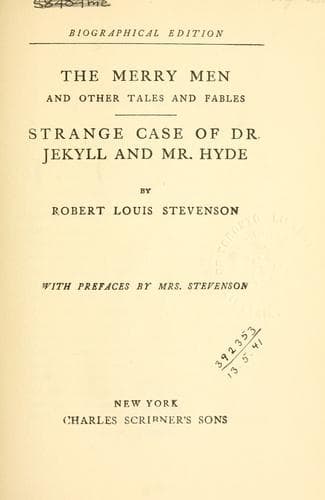
The Merry Men, and Other Tales and FablesStevenson, Robert Louis
History
The Merry Men, and Other Tales and Fables
Stevenson, Robert Louis
Boys -- Fiction; Great Britain -- History -- 19th century -- Fiction; Paranormal fiction; Treasure troves -- Fiction
Doctor Desprez always rose early. Before the smoke arose, before the
first cart rattled over the bridge to the day’s labour in the fields,
he was to be found wandering in his garden. Now he would pick a bunch
of grapes; now he would eat a big pear under the trellice; now he would
draw all sorts of fancies on the path with the end of his cane; now he
would go down and watch the river running endlessly past the timber
landing-place at which he moored his boat. There was no time, he used
to say, for making theories like the early morning. “I rise earlier
than any one else in the village,” he once boasted. “It is a fair
consequence that I know more and wish to do less with my knowledge.”
The Doctor was a connoisseur of sunrises, and loved a good theatrical
effect to usher in the day. He had a theory of dew, by which he could
predict the weather. Indeed, most things served him to that end: the
sound of the bells from all the neighbouring villages, the smell of the
forest, the visits and the behaviour of both birds and fishes, the look
of the plants in his garden, the disposition of cloud, the colour of
the light, and last, although not least, the arsenal of meteorological
instruments in a louvre-boarded hutch upon the lawn. Ever since he had
settled at Gretz, he had been growing more and more into the local
meteorologist, the unpaid champion of the local climate. He thought at
first there was no place so healthful in the arrondissement. By the end
of the second year, he protested there was none so wholesome in the
whole department. And for some time before he met Jean-Marie he had
been prepared to challenge all France and the better part of Europe for
a rival to his chosen spot.
“Doctor,” he would say—“doctor is a foul word. It should not be used to
ladies. It implies disease. I remark it, as a flaw in our civilisation,
that we have not the proper horror of disease. Now I, for my part, have
washed my hands of it; I have renounced my laureation; I am no doctor;
I am only a worshipper of the true goddess Hygieia. Ah, believe me, it
is she who has the cestus! And here, in this exiguous hamlet, has she
placed her shrine: here she dwells and lavishes her gifts; here I walk
with her in the early morning, and she shows me how strong she has made
the peasants, how fruitful she has made the fields, how the trees grow
up tall and comely under her eyes, and the fishes in the river become
clean and agile at her presence.—Rheumatism!” he would cry, on some
malapert interruption, “O, yes, I believe we do have a little
rheumatism. That could hardly be avoided, you know, on a river. And of
course the place stands a little low; and the meadows are marshy,
there’s no doubt. But, my dear sir, look at Bourron! Bourron stands
high. Bourron is close to the forest; plenty of ozone there, you would
say. Well, compared with Gretz, Bourron is a perfect shambles.”
Public-domain text, read in full here on John Shaqi.
Reviews
Reviews
No reviews yet
Be the first to share your thoughts on this work.
Elsewhere in the archive
Join the Discussion
Join the discussion
Sign in to leave a comment or review.
Sign InorCreate an account