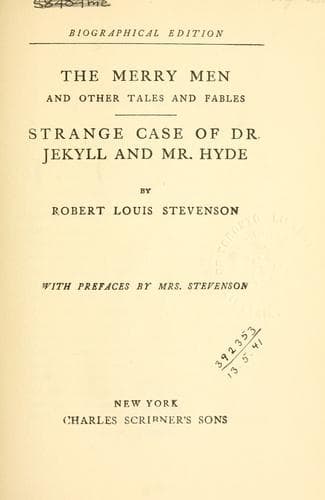
The Merry Men, and Other Tales and FablesStevenson, Robert Louis
History
The Merry Men, and Other Tales and Fables
Stevenson, Robert Louis
Boys -- Fiction; Great Britain -- History -- 19th century -- Fiction; Paranormal fiction; Treasure troves -- Fiction
The morning after he had been summoned to the dying mountebank, the
Doctor visited the wharf at the tail of his garden, and had a long look
at the running water. This he called prayer; but whether his adorations
were addressed to the goddess Hygieia or some more orthodox deity,
never plainly appeared. For he had uttered doubtful oracles, sometimes
declaring that a river was the type of bodily health, sometimes
extolling it as the great moral preacher, continually preaching peace,
continuity, and diligence to man’s tormented spirits. After he had
watched a mile or so of the clear water running by before his eyes,
seen a fish or two come to the surface with a gleam of silver, and
sufficiently admired the long shadows of the trees falling half across
the river from the opposite bank, with patches of moving sunlight in
between, he strolled once more up the garden and through his house into
the street, feeling cool and renovated.
The sound of his feet upon the causeway began the business of the day;
for the village was still sound asleep. The church tower looked very
airy in the sunlight; a few birds that turned about it, seemed to swim
in an atmosphere of more than usual rarity; and the Doctor, walking in
long transparent shadows, filled his lungs amply, and proclaimed
himself well contented with the morning.
On one of the posts before Tentaillon’s carriage entry he espied a
little dark figure perched in a meditative attitude, and immediately
recognised Jean-Marie.
“Aha!” he said, stopping before him humorously, with a hand on either
knee. “So we rise early in the morning, do we? It appears to me that we
have all the vices of a philosopher.”
The boy got to his feet and made a grave salutation.
“And how is our patient?” asked Desprez.
It appeared the patient was about the same.
“And why do you rise early in the morning?” he pursued.
Jean-Marie, after a long silence, professed that he hardly knew.
“You hardly know?” repeated Desprez. “We hardly know anything, my man,
until we try to learn. Interrogate your consciousness. Come, push me
this inquiry home. Do you like it?”
“Yes,” said the boy slowly; “yes, I like it.”
“And why do you like it?” continued the Doctor. “(We are now pursuing
the Socratic method.) Why do you like it?”
“It is quiet,” answered Jean-Marie; “and I have nothing to do; and then
I feel as if I were good.”
Doctor Desprez took a seat on the post at the opposite side. He was
beginning to take an interest in the talk, for the boy plainly thought
before he spoke, and tried to answer truly. “It appears you have a
taste for feeling good,” said the Doctor. “Now, there you puzzle me
extremely; for I thought you said you were a thief; and the two are
incompatible.”
“Is it very bad to steal?” asked Jean-Marie.
“Such is the general opinion, little boy,” replied the Doctor.
Public-domain text, read in full here on John Shaqi.
Reviews
Reviews
No reviews yet
Be the first to share your thoughts on this work.
Elsewhere in the archive
Join the Discussion
Join the discussion
Sign in to leave a comment or review.
Sign InorCreate an account