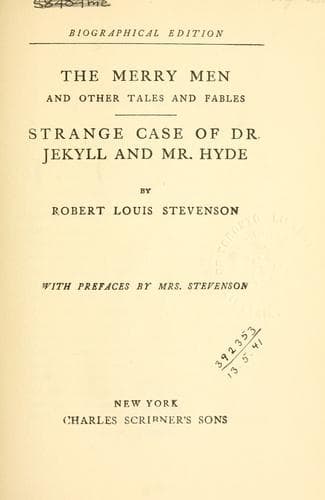
The Merry Men, and Other Tales and FablesStevenson, Robert Louis
History
The Merry Men, and Other Tales and Fables
Stevenson, Robert Louis
Boys -- Fiction; Great Britain -- History -- 19th century -- Fiction; Paranormal fiction; Treasure troves -- Fiction
“You will never do so when the time comes,” said his wife; “I know your
good heart.”
She reached out her hand to him, with a sigh; the Doctor smiled as he
took it and carried it to his lips; he had gained his point with
greater ease than he had dared to hope; for perhaps the twentieth time
he had proved the efficacy of his trusty argument, his Excalibur, the
hint of a return to Paris. Six months in the capital, for a man of the
Doctor’s antecedents and relations, implied no less a calamity than
total ruin. Anastasie had saved the remainder of his fortune by keeping
him strictly in the country. The very name of Paris put her in a blue
fear; and she would have allowed her husband to keep a menagerie in the
back garden, let alone adopting a stable-boy, rather than permit the
question of return to be discussed.
About four of the afternoon, the mountebank rendered up his ghost; he
had never been conscious since his seizure. Doctor Desprez was present
at his last passage, and declared the farce over. Then he took
Jean-Marie by the shoulder and led him out into the inn garden where
there was a convenient bench beside the river. Here he sat him down and
made the boy place himself on his left.
“Jean-Marie,” he said very gravely, “this world is exceedingly vast;
and even France, which is only a small corner of it, is a great place
for a little lad like you. Unfortunately it is full of eager,
shouldering people moving on; and there are very few bakers’ shops for
so many eaters. Your master is dead; you are not fit to gain a living
by yourself; you do not wish to steal? No. Your situation then is
undesirable; it is, for the moment, critical. On the other hand, you
behold in me a man not old, though elderly, still enjoying the youth of
the heart and the intelligence; a man of instruction; easily situated
in this world’s affairs; keeping a good table:—a man, neither as friend
nor host, to be despised. I offer you your food and clothes, and to
teach you lessons in the evening, which will be infinitely more to the
purpose for a lad of your stamp than those of all the priests in
Europe. I propose no wages, but if ever you take a thought to leave me,
the door shall be open, and I will give you a hundred francs to start
the world upon. In return, I have an old horse and chaise, which you
would very speedily learn to clean and keep in order. Do not hurry
yourself to answer, and take it or leave it as you judge aright. Only
remember this, that I am no sentimentalist or charitable person, but a
man who lives rigorously to himself; and that if I make the proposal,
it is for my own ends—it is because I perceive clearly an advantage to
myself. And now, reflect.”
“I shall be very glad. I do not see what else I can do. I thank you,
sir, most kindly, and I will try to be useful,” said the boy.
Public-domain text, read in full here on John Shaqi.
Reviews
Reviews
No reviews yet
Be the first to share your thoughts on this work.
Elsewhere in the archive
Join the Discussion
Join the discussion
Sign in to leave a comment or review.
Sign InorCreate an account