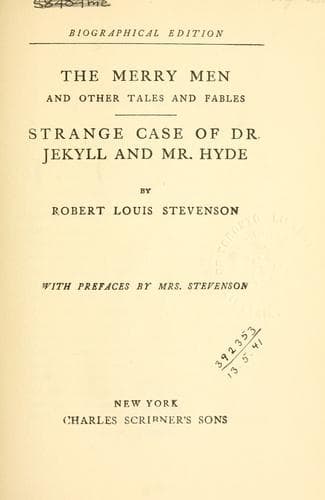
The Merry Men, and Other Tales and FablesStevenson, Robert Louis
History
The Merry Men, and Other Tales and Fables
Stevenson, Robert Louis
Boys -- Fiction; Great Britain -- History -- 19th century -- Fiction; Paranormal fiction; Treasure troves -- Fiction
“Not so, my dear,” he replied; “I retain its complete exercise. To the
proof: instead of attempting to cloak my inconsistency, I have, by way
of preparing you, thrown it into strong relief. You will there, I
think, recognise the philosopher who has the ecstasy to call you wife.
The fact is, I have been reckoning all this while without an accident.
I never thought to find a son of my own. Now, last night, I found one.
Do not unnecessarily alarm yourself, my dear; he is not a drop of blood
to me that I know. It is his mind, darling, his mind that calls me
father.”
“His mind!” she repeated with a titter between scorn and hysterics.
“His mind, indeed! Henri, is this an idiotic pleasantry, or are you
mad? His mind! And what of my mind?”
“Truly,” replied the Doctor with a shrug, “you have your finger on the
hitch. He will be strikingly antipathetic to my ever beautiful
Anastasie. She will never understand him; he will never understand her.
You married the animal side of my nature, dear and it is on the
spiritual side that I find my affinity for Jean-Marie. So much so,
that, to be perfectly frank, I stand in some awe of him myself. You
will easily perceive that I am announcing a calamity for you. Do not,”
he broke out in tones of real solicitude—“do not give way to tears
after a meal, Anastasie. You will certainly give yourself a false
digestion.”
Anastasie controlled herself. “You know how willing I am to humour
you,” she said, “in all reasonable matters. But on this point—”
“My dear love,” interrupted the Doctor, eager to prevent a refusal,
“who wished to leave Paris? Who made me give up cards, and the opera,
and the boulevard, and my social relations, and all that was my life
before I knew you? Have I been faithful? Have I been obedient? Have I
not borne my doom with cheerfulness? In all honesty, Anastasie, have I
not a right to a stipulation on my side? I have, and you know it. I
stipulate my son.”
Anastasie was aware of defeat; she struck her colours instantly. “You
will break my heart,” she sighed.
“Not in the least,” said he. “You will feel a trifling inconvenience
for a month, just as I did when I was first brought to this vile
hamlet; then your admirable sense and temper will prevail, and I see
you already as content as ever, and making your husband the happiest of
men.”
“You know I can refuse you nothing,” she said, with a last flicker of
resistance; “nothing that will make you truly happier. But will this?
Are you sure, my husband? Last night, you say, you found him! He may be
the worst of humbugs.”
“I think not,” replied the Doctor. “But do not suppose me so unwary as
to adopt him out of hand. I am, I flatter myself, a finished man of the
world; I have had all possibilities in view; my plan is contrived to
meet them all. I take the lad as stable boy. If he pilfer, if he
grumble, if he desire to change, I shall see I was mistaken; I shall
recognise him for no son of mine, and send him tramping.”
Public-domain text, read in full here on John Shaqi.
Reviews
Reviews
No reviews yet
Be the first to share your thoughts on this work.
Elsewhere in the archive
Join the Discussion
Join the discussion
Sign in to leave a comment or review.
Sign InorCreate an account