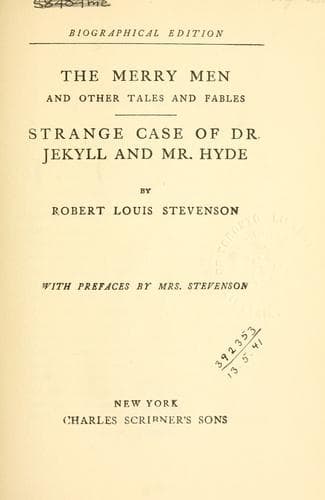
The Merry Men, and Other Tales and FablesStevenson, Robert Louis
History
The Merry Men, and Other Tales and Fables
Stevenson, Robert Louis
Boys -- Fiction; Great Britain -- History -- 19th century -- Fiction; Paranormal fiction; Treasure troves -- Fiction
The Doctor’s system of hygiene strikingly coincided with his tastes;
and his picture of the perfect life was a faithful description of the
one he was leading at the time. But it is easy to convince a boy, whom
you supply with all the facts for the discussion. And besides, there
was one thing admirable in the philosophy, and that was the enthusiasm
of the philosopher. There was never any one more vigorously determined
to be pleased; and if he was not a great logician, and so had no right
to convince the intellect, he was certainly something of a poet, and
had a fascination to seduce the heart. What he could not achieve in his
customary humour of a radiant admiration of himself and his
circumstances, he sometimes effected in his fits of gloom.
“Boy,” he would say, “avoid me to-day. If I were superstitious, I
should even beg for an interest in your prayers. I am in the black fit;
the evil spirit of King Saul, the hag of the merchant Abudah, the
personal devil of the mediæval monk, is with me—is in me,” tapping on
his breast. “The vices of my nature are now uppermost; innocent
pleasures woo me in vain; I long for Paris, for my wallowing in the
mire. See,” he would continue, producing a handful of silver, “I denude
myself, I am not to be trusted with the price of a fare. Take it, keep
it for me, squander it on deleterious candy, throw it in the deepest of
the river—I will homologate your action. Save me from that part of
myself which I disown. If you see me falter, do not hesitate; if
necessary, wreck the train! I speak, of course, by a parable. Any
extremity were better than for me to reach Paris alive.”
Doubtless the Doctor enjoyed these little scenes, as a variation in his
part; they represented the Byronic element in the somewhat artificial
poetry of his existence; but to the boy, though he was dimly aware of
their theatricality, they represented more. The Doctor made perhaps too
little, the boy possibly too much, of the reality and gravity of these
temptations.
One day a great light shone for Jean-Marie. “Could not riches be used
well?” he asked.
“In theory, yes,” replied the Doctor. “But it is found in experience
that no one does so. All the world imagine they will be exceptional
when they grow wealthy; but possession is debasing, new desires spring
up; and the silly taste for ostentation eats out the heart of
pleasure.”
“Then you might be better if you had less,” said the boy.
“Certainly not,” replied the Doctor; but his voice quavered as he
spoke.
“Why?” demanded pitiless innocence.
Doctor Desprez saw all the colours of the rainbow in a moment; the
stable universe appeared to be about capsizing with him. “Because,”
said he—affecting deliberation after an obvious pause—“because I have
formed my life for my present income. It is not good for men of my
years to be violently dissevered from their habits.”
Public-domain text, read in full here on John Shaqi.
Reviews
Reviews
No reviews yet
Be the first to share your thoughts on this work.
Elsewhere in the archive
Join the Discussion
Join the discussion
Sign in to leave a comment or review.
Sign InorCreate an account