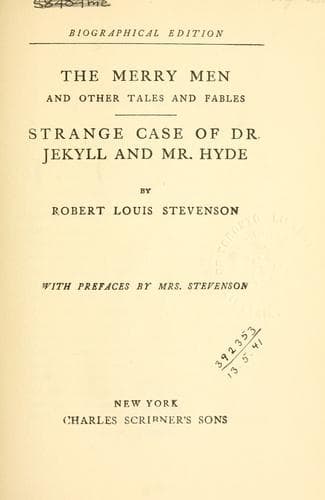
The Merry Men, and Other Tales and FablesStevenson, Robert Louis
History
The Merry Men, and Other Tales and Fables
Stevenson, Robert Louis
Boys -- Fiction; Great Britain -- History -- 19th century -- Fiction; Paranormal fiction; Treasure troves -- Fiction
That was a sharp brush. The Doctor breathed hard, and fell into
taciturnity for the afternoon. As for the boy, he was delighted with
the resolution of his doubts; even wondered that he had not foreseen
the obvious and conclusive answer. His faith in the Doctor was a stout
piece of goods. Desprez was inclined to be a sheet in the wind’s eye
after dinner, especially after Rhone wine, his favourite weakness. He
would then remark on the warmth of his feeling for Anastasie, and with
inflamed cheeks and a loose, flustered smile, debate upon all sorts of
topics, and be feebly and indiscreetly witty. But the adopted
stable-boy would not permit himself to entertain a doubt that savoured
of ingratitude. It is quite true that a man may be a second father to
you, and yet take too much to drink; but the best natures are ever slow
to accept such truths.
The Doctor thoroughly possessed his heart, but perhaps he exaggerated
his influence over his mind. Certainly Jean-Marie adopted some of his
master’s opinions, but I have yet to learn that he ever surrendered one
of his own. Convictions existed in him by divine right; they were
virgin, unwrought, the brute metal of decision. He could add others
indeed, but he could not put away; neither did he care if they were
perfectly agreed among themselves; and his spiritual pleasures had
nothing to do with turning them over or justifying them in words. Words
were with him a mere accomplishment, like dancing. When he was by
himself, his pleasures were almost vegetable. He would slip into the
woods towards Acheres, and sit in the mouth of a cave among grey
birches. His soul stared straight out of his eyes; he did not move or
think; sunlight, thin shadows moving in the wind, the edge of firs
against the sky, occupied and bound his faculties. He was pure unity, a
spirit wholly abstracted. A single mood filled him, to which all the
objects of sense contributed, as the colours of the spectrum merge and
disappear in white light.
So while the Doctor made himself drunk with words, the adopted
stable-boy bemused himself with silence.
CHAPTER V.
TREASURE TROVE.
The Doctor’s carriage was a two-wheeled gig with a hood; a kind of
vehicle in much favour among country doctors. On how many roads has one
not seen it, a great way off between the poplars!—in how many village
streets, tied to a gate-post! This sort of chariot is
affected—particularly at the trot—by a kind of pitching movement to and
fro across the axle, which well entitles it to the style of a Noddy.
The hood describes a considerable arc against the landscape, with a
solemnly absurd effect on the contemplative pedestrian. To ride in such
a carriage cannot be numbered among the things that appertain to glory;
but I have no doubt it may be useful in liver complaint. Thence,
perhaps, its wide popularity among physicians.
Public-domain text, read in full here on John Shaqi.
Reviews
Reviews
No reviews yet
Be the first to share your thoughts on this work.
Elsewhere in the archive
Join the Discussion
Join the discussion
Sign in to leave a comment or review.
Sign InorCreate an account