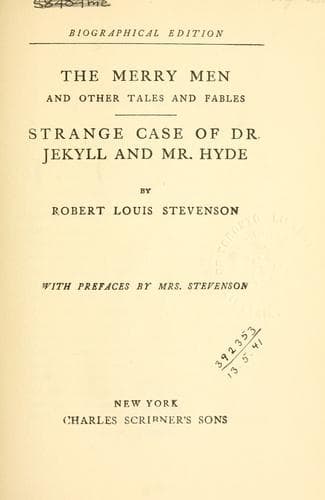
The Merry Men, and Other Tales and FablesStevenson, Robert Louis
History
The Merry Men, and Other Tales and Fables
Stevenson, Robert Louis
Boys -- Fiction; Great Britain -- History -- 19th century -- Fiction; Paranormal fiction; Treasure troves -- Fiction
“Singular being!” said Desprez. “But I divagate (I perceive in a
thousand ways that I grow old). Franchard was at length destroyed in
the English wars, the same that levelled Gretz. But—here is the
point—the hermits (for there were already more than one) had foreseen
the danger and carefully concealed the sacrificial vessels. These
vessels were of monstrous value, Jean-Marie—monstrous value—priceless,
we may say; exquisitely worked, of exquisite material. And now, mark
me, they have never been found. In the reign of Louis Quatorze some
fellows were digging hard by the ruins. Suddenly—tock!—the spade hit
upon an obstacle. Imagine the men fooling one to another; imagine how
their hearts bounded, how their colour came and went. It was a coffer,
and in Franchard the place of buried treasure! They tore it open like
famished beasts. Alas! it was not the treasure; only some priestly
robes, which, at the touch of the eating air, fell upon themselves and
instantly wasted into dust. The perspiration of these good fellows
turned cold upon them, Jean-Marie. I will pledge my reputation, if
there was anything like a cutting wind, one or other had a pneumonia
for his trouble.”
“I should like to have seen them turning into dust,” said Jean-Marie.
“Otherwise, I should not have cared so greatly.”
“You have no imagination,” cried the Doctor. “Picture to yourself the
scene. Dwell on the idea—a great treasure lying in the earth for
centuries: the material for a giddy, copious, opulent existence not
employed; dresses and exquisite pictures unseen; the swiftest galloping
horses not stirring a hoof, arrested by a spell; women with the
beautiful faculty of smiles, not smiling; cards, dice, opera singing,
orchestras, castles, beautiful parks and gardens, big ships with a
tower of sailcloth, all lying unborn in a coffin—and the stupid trees
growing overhead in the sunlight, year after year. The thought drives
one frantic.”
“It is only money,” replied Jean-Marie. “It would do harm.”
“O, come!” cried Desprez, “that is philosophy; it is all very fine, but
not to the point just now. And besides, it is not ‘only money,’ as you
call it; there are works of art in the question; the vessels were
carved. You speak like a child. You weary me exceedingly, quoting my
words out of all logical connection, like a parroquet.”
“And at any rate, we have nothing to do with it,” returned the boy
submissively.
Public-domain text, read in full here on John Shaqi.
Reviews
Reviews
No reviews yet
Be the first to share your thoughts on this work.
Elsewhere in the archive
Join the Discussion
Join the discussion
Sign in to leave a comment or review.
Sign InorCreate an account