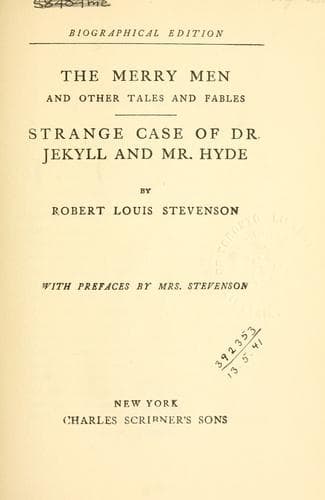
The Merry Men, and Other Tales and FablesStevenson, Robert Louis
History
The Merry Men, and Other Tales and Fables
Stevenson, Robert Louis
Boys -- Fiction; Great Britain -- History -- 19th century -- Fiction; Paranormal fiction; Treasure troves -- Fiction
One morning early, Jean-Marie led forth the Doctor’s noddy, opened the
gate, and mounted to the driving-seat. The Doctor followed, arrayed
from top to toe in spotless linen, armed with an immense flesh-coloured
umbrella, and girt with a botanical case on a baldric; and the equipage
drove off smartly in a breeze of its own provocation. They were bound
for Franchard, to collect plants, with an eye to the “Comparative
Pharmacopoeia.”
A little rattling on the open roads, and they came to the borders of
the forest and struck into an unfrequented track; the noddy yawed
softly over the sand, with an accompaniment of snapping twigs. There
was a great, green, softly murmuring cloud of congregated foliage
overhead. In the arcades of the forest the air retained the freshness
of the night. The athletic bearing of the trees, each carrying its
leafy mountain, pleased the mind like so many statues; and the lines of
the trunk led the eye admiringly upward to where the extreme leaves
sparkled in a patch of azure. Squirrels leaped in mid air. It was a
proper spot for a devotee of the goddess Hygieia.
“Have you been to Franchard, Jean-Marie?” inquired the Doctor. “I fancy
not.”
“Never,” replied the boy.
“It is ruin in a gorge,” continued Desprez, adopting his expository
voice; “the ruin of a hermitage and chapel. History tells us much of
Franchard; how the recluse was often slain by robbers; how he lived on
a most insufficient diet; how he was expected to pass his days in
prayer. A letter is preserved, addressed to one of these solitaries by
the superior of his order, full of admirable hygienic advice; bidding
him go from his book to praying, and so back again, for variety’s sake,
and when he was weary of both to stroll about his garden and observe
the honey bees. It is to this day my own system. You must often have
remarked me leaving the ‘Pharmacopoeia’—often even in the middle of a
phrase—to come forth into the sun and air. I admire the writer of that
letter from my heart; he was a man of thought on the most important
subjects. But, indeed, had I lived in the Middle Ages (I am heartily
glad that I did not) I should have been an eremite myself—if I had not
been a professed buffoon, that is. These were the only philosophical
lives yet open: laughter or prayer; sneers, we might say, and tears.
Until the sun of the Positive arose, the wise man had to make his
choice between these two.”
“I have been a buffoon, of course,” observed Jean-Marie.
“I cannot imagine you to have excelled in your profession,” said the
Doctor, admiring the boy’s gravity. “Do you ever laugh?”
“Oh, yes,” replied the other. “I laugh often. I am very fond of jokes.”
Public-domain text, read in full here on John Shaqi.
Reviews
Reviews
No reviews yet
Be the first to share your thoughts on this work.
Elsewhere in the archive
Join the Discussion
Join the discussion
Sign in to leave a comment or review.
Sign InorCreate an account