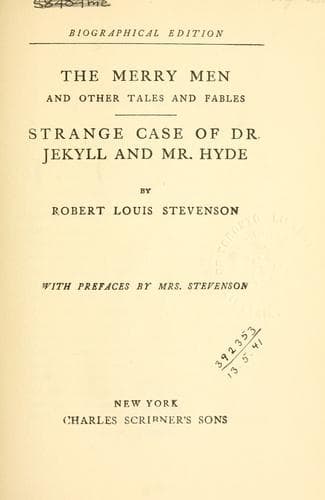
The Merry Men, and Other Tales and FablesStevenson, Robert Louis
History
The Merry Men, and Other Tales and Fables
Stevenson, Robert Louis
Boys -- Fiction; Great Britain -- History -- 19th century -- Fiction; Paranormal fiction; Treasure troves -- Fiction
“Once in a way,” he said at last, by way of a concession to the boy’s
more rigorous attitude, “once in a way, and at so critical a moment,
this ale is a nectar for the gods. The habit, indeed, is debasing;
wine, the juice of the grape, is the true drink of the Frenchman, as I
have often had occasion to point out; and I do not know that I can
blame you for refusing this outlandish stimulant. You can have some
wine and cakes. Is the bottle empty? Well, we will not be proud; we
will have pity on your glass.”
The beer being done, the Doctor chafed bitterly while Jean-Marie
finished his cakes. “I burn to be gone,” he said, looking at his watch.
“Good God, how slow you eat!” And yet to eat slowly was his own
particular prescription, the main secret of longevity!
His martyrdom, however, reached an end at last; the pair resumed their
places in the buggy, and Desprez, leaning luxuriously back, announced
his intention of proceeding to Fontainebleau.
“To Fontainebleau?” repeated Jean-Marie.
“My words are always measured,” said the Doctor. “On!”
The Doctor was driven through the glades of paradise; the air, the
light, the shining leaves, the very movements of the vehicle, seemed to
fall in tune with his golden meditations; with his head thrown back, he
dreamed a series of sunny visions, ale and pleasure dancing in his
veins. At last he spoke.
“I shall telegraph for Casimir,” he said. “Good Casimir! a fellow of
the lower order of intelligence, Jean-Marie, distinctly not creative,
not poetic; and yet he will repay your study; his fortune is vast, and
is entirely due to his own exertions. He is the very fellow to help us
to dispose of our trinkets, find us a suitable house in Paris, and
manage the details of our installation. Admirable Casimir, one of my
oldest comrades! It was on his advice, I may add, that I invested my
little fortune in Turkish bonds; when we have added these spoils of the
mediæval church to our stake in the Mahometan empire, little boy, we
shall positively roll among doubloons, positively roll! Beautiful
forest,” he cried, “farewell! Though called to other scenes, I will not
forget thee. Thy name is graven in my heart. Under the influence of
prosperity I become dithyrambic, Jean-Marie. Such is the impulse of the
natural soul; such was the constitution of primæval man. And I—well, I
will not refuse the credit—I have preserved my youth like a virginity;
another, who should have led the same snoozing, countryfied existence
for these years, another had become rusted, become stereotype; but I, I
praise my happy constitution, retain the spring unbroken. Fresh
opulence and a new sphere of duties find me unabated in ardour and only
more mature by knowledge. For this prospective change, Jean-Marie—it
may probably have shocked you. Tell me now, did it not strike you as an
inconsistency? Confess—it is useless to dissemble—it pained you?”
“Yes,” said the boy.
Public-domain text, read in full here on John Shaqi.
Reviews
Reviews
No reviews yet
Be the first to share your thoughts on this work.
Elsewhere in the archive
Join the Discussion
Join the discussion
Sign in to leave a comment or review.
Sign InorCreate an account