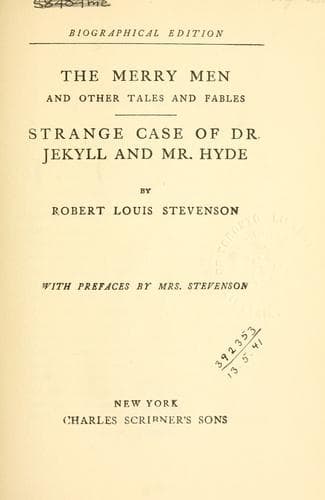
The Merry Men, and Other Tales and FablesStevenson, Robert Louis
History
The Merry Men, and Other Tales and Fables
Stevenson, Robert Louis
Boys -- Fiction; Great Britain -- History -- 19th century -- Fiction; Paranormal fiction; Treasure troves -- Fiction
“You see,” returned the Doctor, with sublime fatuity, “I read your
thoughts! Nor am I surprised—your education is not yet complete; the
higher duties of men have not been yet presented to you fully. A
hint—till we have leisure—must suffice. Now that I am once more in
possession of a modest competence; now that I have so long prepared
myself in silent meditation, it becomes my superior duty to proceed to
Paris. My scientific training, my undoubted command of language, mark
me out for the service of my country. Modesty in such a case would be a
snare. If sin were a philosophical expression, I should call it sinful.
A man must not deny his manifest abilities, for that is to evade his
obligations. I must be up and doing; I must be no skulker in life’s
battle.”
So he rattled on, copiously greasing the joint of his inconsistency
with words; while the boy listened silently, his eyes fixed on the
horse, his mind seething. It was all lost eloquence; no array of words
could unsettle a belief of Jean-Marie’s; and he drove into
Fontainebleau filled with pity, horror, indignation, and despair.
In the town Jean-Marie was kept a fixture on the driving-seat, to guard
the treasure; while the Doctor, with a singular, slightly tipsy
airiness of manner, fluttered in and out of cafés, where he shook hands
with garrison officers, and mixed an absinthe with the nicety of old
experience; in and out of shops, from which he returned laden with
costly fruits, real turtle, a magnificent piece of silk for his wife, a
preposterous cane for himself, and a kepi of the newest fashion for the
boy; in and out of the telegraph office, whence he despatched his
telegram, and where three hours later he received an answer promising a
visit on the morrow; and generally pervaded Fontainebleau with the
first fine aroma of his divine good humour.
The sun was very low when they set forth again; the shadows of the
forest trees extended across the broad white road that led them home;
the penetrating odour of the evening wood had already arisen, like a
cloud of incense, from that broad field of tree-tops; and even in the
streets of the town, where the air had been baked all day between white
walls, it came in whiffs and pulses, like a distant music. Half-way
home, the last gold flicker vanished from a great oak upon the left;
and when they came forth beyond the borders of the wood, the plain was
already sunken in pearly greyness, and a great, pale moon came swinging
skyward through the filmy poplars.
Public-domain text, read in full here on John Shaqi.
Reviews
Reviews
No reviews yet
Be the first to share your thoughts on this work.
Elsewhere in the archive
Join the Discussion
Join the discussion
Sign in to leave a comment or review.
Sign InorCreate an account