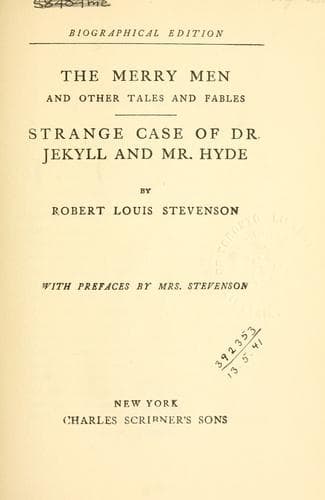
The Merry Men, and Other Tales and FablesStevenson, Robert Louis
History
The Merry Men, and Other Tales and Fables
Stevenson, Robert Louis
Boys -- Fiction; Great Britain -- History -- 19th century -- Fiction; Paranormal fiction; Treasure troves -- Fiction
“Desprez,” interrupted Casimir, “for Heaven’s sake be a man of the
world. You telegraph me to leave my business and come down here on
yours. I come, I ask the business, you say ‘Find me this thief!’ Well,
I find him; I say ‘There he is!’ You need not like it, but you have no
manner of right to take offence.”
“Well,” returned the Doctor, “I grant that; I will even thank you for
your mistaken zeal. But your hypothesis was so extravagantly
monstrous—”
“Look here,” interrupted Casimir; “was it you or Stasie?”
“Certainly not,” answered the Doctor.
“Very well; then it was the boy. Say no more about it,” said the
brother-in-law, and he produced his cigar-case.
“I will say this much more,” returned Desprez: “if that boy came and
told me so himself, I should not believe him; and if I did believe him,
so implicit is my trust, I should conclude that he had acted for the
best.”
“Well, well,” said Casimir, indulgently. “Have you a light? I must be
going. And by the way, I wish you would let me sell your Turks for you.
I always told you, it meant smash. I tell you so again. Indeed, it was
partly that that brought me down. You never acknowledge my letters—a
most unpardonable habit.”
“My good brother,” replied the Doctor blandly, “I have never denied
your ability in business; but I can perceive your limitations.”
“Egad, my friend, I can return the compliment,” observed the man of
business. “Your limitation is to be downright irrational.”
“Observe the relative position,” returned the Doctor with a smile. “It
is your attitude to believe through thick and thin in one man’s
judgment—your own. I follow the same opinion, but critically and with
open eyes. Which is the more irrational?—I leave it to yourself.”
“O, my dear fellow!” cried Casimir, “stick to your Turks, stick to your
stable-boy, go to the devil in general in your own way and be done with
it. But don’t ratiocinate with me—I cannot bear it. And so, ta-ta. I
might as well have stayed away for any good I’ve done. Say good-bye
from me to Stasie, and to the sullen hang-dog of a stable-boy, if you
insist on it; I’m off.”
And Casimir departed. The Doctor, that night, dissected his character
before Anastasie. “One thing, my beautiful,” he said, “he has learned
one thing from his lifelong acquaintance with your husband: the word
_ratiocinate_. It shines in his vocabulary, like a jewel in a
muck-heap. And, even so, he continually misapplies it. For you must
have observed he uses it as a sort of taunt, in the sense of to
_ergotise_, implying, as it were—the poor, dear fellow!—a vein of
sophistry. As for his cruelty to Jean-Marie, it must be forgiven him—it
is not his nature, it is the nature of his life. A man who deals with
money, my dear, is a man lost.”
Public-domain text, read in full here on John Shaqi.
Reviews
Reviews
No reviews yet
Be the first to share your thoughts on this work.
Elsewhere in the archive
Join the Discussion
Join the discussion
Sign in to leave a comment or review.
Sign InorCreate an account