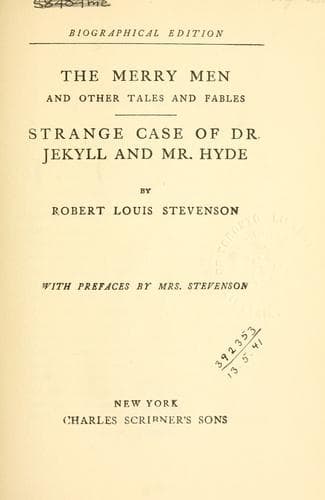
The Merry Men, and Other Tales and FablesStevenson, Robert Louis
History
The Merry Men, and Other Tales and Fables
Stevenson, Robert Louis
Boys -- Fiction; Great Britain -- History -- 19th century -- Fiction; Paranormal fiction; Treasure troves -- Fiction
With Jean-Marie the process of reconciliation had been somewhat slow.
At first he was inconsolable, insisted on leaving the family, went from
paroxysm to paroxysm of tears; and it was only after Anastasie had been
closeted for an hour with him, alone, that she came forth, sought out
the Doctor, and, with tears in her eyes, acquainted that gentleman with
what had passed.
“At first, my husband, he would hear of nothing,” she said. “Imagine!
if he had left us! what would the treasure be to that? Horrible
treasure, it has brought all this about! At last, after he has sobbed
his very heart out, he agrees to stay on a condition—we are not to
mention this matter, this infamous suspicion, not even to mention the
robbery. On that agreement only, the poor, cruel boy will consent to
remain among his friends.”
“But this inhibition,” said the Doctor, “this embargo—it cannot
possibly apply to me?”
“To all of us,” Anastasie assured him.
“My cherished one,” Desprez protested, “you must have misunderstood. It
cannot apply to me. He would naturally come to me.”
“Henri,” she said, “it does; I swear to you it does.”
“This is a painful, a very painful circumstance,” the Doctor said,
looking a little black. “I cannot affect, Anastasie, to be anything but
justly wounded. I feel this, I feel it, my wife, acutely.”
“I knew you would,” she said. “But if you had seen his distress! We
must make allowances, we must sacrifice our feelings.”
“I trust, my dear, you have never found me averse to sacrifices,”
returned the Doctor very stiffly.
“And you will let me go and tell him that you have agreed? It will be
like your noble nature,” she cried.
So it would, he perceived—it would be like his noble nature! Up jumped
his spirits, triumphant at the thought. “Go, darling,” he said nobly,
“reassure him. The subject is buried; more—I make an effort, I have
accustomed my will to these exertions—and it is forgotten.”
A little after, but still with swollen eyes and looking mortally
sheepish, Jean-Marie reappeared and went ostentatiously about his
business. He was the only unhappy member of the party that sat down
that night to supper. As for the Doctor, he was radiant. He thus sang
the requiem of the treasure:—
“This has been, on the whole, a most amusing episode,” he said. “We are
not a penny the worse—nay, we are immensely gainers. Our philosophy has
been exercised; some of the turtle is still left—the most wholesome of
delicacies; I have my staff, Anastasie has her new dress, Jean-Marie is
the proud possessor of a fashionable kepi. Besides, we had a glass of
Hermitage last night; the glow still suffuses my memory. I was growing
positively niggardly with that Hermitage, positively niggardly. Let me
take the hint: we had one bottle to celebrate the appearance of our
visionary fortune; let us have a second to console us for its
occultation. The third I hereby dedicate to Jean-Marie’s wedding
breakfast.”
CHAPTER VII.
THE FALL OF THE HOUSE OF DESPREZ.
Public-domain text, read in full here on John Shaqi.
Reviews
Reviews
No reviews yet
Be the first to share your thoughts on this work.
Elsewhere in the archive
Join the Discussion
Join the discussion
Sign in to leave a comment or review.
Sign InorCreate an account