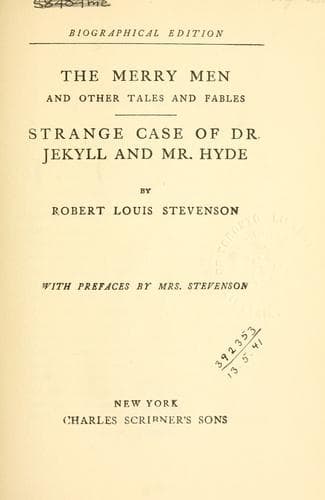
The Merry Men, and Other Tales and FablesStevenson, Robert Louis
History
The Merry Men, and Other Tales and Fables
Stevenson, Robert Louis
Boys -- Fiction; Great Britain -- History -- 19th century -- Fiction; Paranormal fiction; Treasure troves -- Fiction
“Silence,” the Doctor moralised—“you see, Anastasie, what comes of
silence. Had the boy properly unbosomed himself, the little
disappointment about the treasure, the little annoyance about Casimir’s
incivility, would long ago have been forgotten. As it is, they prey
upon him like a disease. He loses flesh, his appetite is variable and,
on the whole, impaired. I keep him on the strictest regimen, I exhibit
the most powerful tonics; both in vain.”
“Don’t you think you drug him too much?” asked madame, with an
irrepressible shudder.
“Drug?” cried the Doctor; “I drug? Anastasie, you are mad!”
Time went on, and the boy’s health still slowly declined. The Doctor
blamed the weather, which was cold and boisterous. He called in his
_confrère_ from Bourron, took a fancy for him, magnified his capacity,
and was pretty soon under treatment himself—it scarcely appeared for
what complaint. He and Jean-Marie had each medicine to take at
different periods of the day. The Doctor used to lie in wait for the
exact moment, watch in hand. “There is nothing like regularity,” he
would say, fill out the doses, and dilate on the virtues of the
draught; and if the boy seemed none the better, the Doctor was not at
all the worse.
Gunpowder Day, the boy was particularly low. It was scowling, squally
weather. Huge broken companies of cloud sailed swiftly overhead; raking
gleams of sunlight swept the village, and were followed by intervals of
darkness and white, flying rain. At times the wind lifted up its voice
and bellowed. The trees were all scourging themselves along the
meadows, the last leaves flying like dust.
The Doctor, between the boy and the weather, was in his element; he had
a theory to prove. He sat with his watch out and a barometer in front
of him, waiting for the squalls and noting their effect upon the human
pulse. “For the true philosopher,” he remarked delightedly, “every fact
in nature is a toy.” A letter came to him; but, as its arrival
coincided with the approach of another gust, he merely crammed it into
his pocket, gave the time to Jean-Marie, and the next moment they were
both counting their pulses as if for a wager.
At nightfall the wind rose into a tempest. It besieged the hamlet,
apparently from every side, as if with batteries of cannon; the houses
shook and groaned; live coals were blown upon the floor. The uproar and
terror of the night kept people long awake, sitting with pallid faces
giving ear.
It was twelve before the Desprez family retired. By half-past one, when
the storm was already somewhat past its height, the Doctor was awakened
from a troubled slumber, and sat up. A noise still rang in his ears,
but whether of this world or the world of dreams he was not certain.
Another clap of wind followed. It was accompanied by a sickening
movement of the whole house, and in the subsequent lull Desprez could
hear the tiles pouring like a cataract into the loft above his head. He
plucked Anastasie bodily out of bed.
Public-domain text, read in full here on John Shaqi.
Reviews
Reviews
No reviews yet
Be the first to share your thoughts on this work.
Elsewhere in the archive
Join the Discussion
Join the discussion
Sign in to leave a comment or review.
Sign InorCreate an account