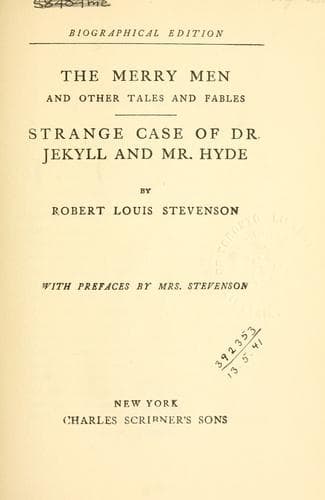
The Merry Men, and Other Tales and FablesStevenson, Robert Louis
History
The Merry Men, and Other Tales and Fables
Stevenson, Robert Louis
Boys -- Fiction; Great Britain -- History -- 19th century -- Fiction; Paranormal fiction; Treasure troves -- Fiction
The Doctor’s house has not yet received the compliment of a
description, and it is now high time that the omission were supplied,
for the house is itself an actor in the story, and one whose part is
nearly at an end. Two stories in height, walls of a warm yellow, tiles
of an ancient ruddy brown diversified with moss and lichen, it stood
with one wall to the street in the angle of the Doctor’s property. It
was roomy, draughty, and inconvenient. The large rafters were here and
there engraven with rude marks and patterns; the handrail of the stair
was carved in countrified arabesque; a stout timber pillar, which did
duty to support the dining-room roof, bore mysterious characters on its
darker side, runes, according to the Doctor; nor did he fail, when he
ran over the legendary history of the house and its possessors, to
dwell upon the Scandinavian scholar who had left them. Floors, doors,
and rafters made a great variety of angles; every room had a particular
inclination; the gable had tilted towards the garden, after the manner
of a leaning tower, and one of the former proprietors had buttressed
the building from that side with a great strut of wood, like the
derrick of a crane. Altogether, it had many marks of ruin; it was a
house for the rats to desert; and nothing but its excellent
brightness—the window-glass polished and shining, the paint well
scoured, the brasses radiant, the very prop all wreathed about with
climbing flowers—nothing but its air of a well-tended, smiling veteran,
sitting, crutch and all, in the sunny corner of a garden, marked it as
a house for comfortable people to inhabit. In poor or idle management
it would soon have hurried into the blackguard stages of decay. As it
was, the whole family loved it, and the Doctor was never better
inspired than when he narrated its imaginary story and drew the
character of its successive masters, from the Hebrew merchant who had
re-edified its walls after the sack of the town, and past the
mysterious engraver of the runes, down to the long-headed, dirty-handed
boor from whom he had himself acquired it at a ruinous expense. As for
any alarm about its security, the idea had never presented itself. What
had stood four centuries might well endure a little longer.
Indeed, in this particular winter, after the finding and losing of the
treasure, the Desprez’ had an anxiety of a very different order, and
one which lay nearer their hearts. Jean-Marie was plainly not himself.
He had fits of hectic activity, when he made unusual exertions to
please, spoke more and faster, and redoubled in attention to his
lessons. But these were interrupted by spells of melancholia and
brooding silence, when the boy was little better than unbearable.
Public-domain text, read in full here on John Shaqi.
Reviews
Reviews
No reviews yet
Be the first to share your thoughts on this work.
Elsewhere in the archive
Join the Discussion
Join the discussion
Sign in to leave a comment or review.
Sign InorCreate an account