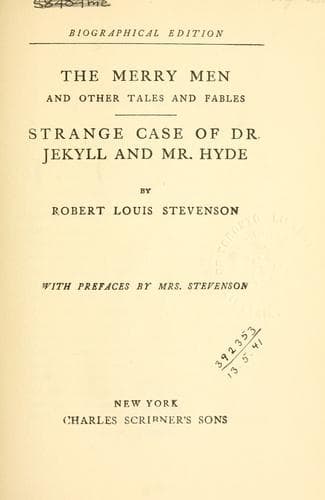
The Merry Men, and Other Tales and FablesStevenson, Robert Louis
History
The Merry Men, and Other Tales and Fables
Stevenson, Robert Louis
Boys -- Fiction; Great Britain -- History -- 19th century -- Fiction; Paranormal fiction; Treasure troves -- Fiction
By the first glimpse of day the party sallied forth from the fireside
into the street. The wind had fallen, but still charioted a world of
troubled clouds; the air bit like frost; and the party, as they stood
about the ruins in the rainy twilight of the morning, beat upon their
breasts and blew into their hands for warmth. The house had entirely
fallen, the walls outward, the roof in; it was a mere heap of rubbish,
with here and there a forlorn spear of broken rafter. A sentinel was
placed over the ruins to protect the property, and the party adjourned
to Tentaillon’s to break their fast at the Doctor’s expense. The bottle
circulated somewhat freely; and before they left the table it had begun
to snow.
For three days the snow continued to fall, and the ruins, covered with
tarpaulin and watched by sentries, were left undisturbed. The Desprez’
meanwhile had taken up their abode at Tentaillon’s. Madame spent her
time in the kitchen, concocting little delicacies, with the admiring
aid of Madame Tentaillon, or sitting by the fire in thoughtful
abstraction. The fall of the house affected her wonderfully little;
that blow had been parried by another; and in her mind she was
continually fighting over again the battle of the trousers. Had she
done right? Had she done wrong? And now she would applaud her
determination; and anon, with a horrid flush of unavailing penitence,
she would regret the trousers. No juncture in her life had so much
exercised her judgment. In the meantime the Doctor had become vastly
pleased with his situation. Two of the summer boarders still lingered
behind the rest, prisoners for lack of a remittance; they were both
English, but one of them spoke French pretty fluently, and was,
besides, a humorous, agile-minded fellow, with whom the Doctor could
reason by the hour, secure of comprehension. Many were the glasses they
emptied, many the topics they discussed.
“Anastasie,” the Doctor said on the third morning, “take an example
from your husband, from Jean-Marie! The excitement has done more for
the boy than all my tonics, he takes his turn as sentry with positive
gusto. As for me, you behold me. I have made friends with the
Egyptians; and my Pharaoh is, I swear it, a most agreeable companion.
You alone are hipped. About a house—a few dresses? What are they in
comparison to the ‘Pharmacopoeia’—the labour of years lying buried
below stones and sticks in this depressing hamlet? The snow falls; I
shake it from my cloak! Imitate me. Our income will be impaired, I
grant it, since we must rebuild; but moderation, patience, and
philosophy will gather about the hearth. In the meanwhile, the
Tentaillons are obliging; the table, with your additions, will pass;
only the wine is execrable—well, I shall send for some to-day. My
Pharaoh will be gratified to drink a decent glass; aha! and I shall see
if he possesses that acme of organisation—a palate. If he has a palate,
he is perfect.”
Public-domain text, read in full here on John Shaqi.
Reviews
Reviews
No reviews yet
Be the first to share your thoughts on this work.
Elsewhere in the archive
Join the Discussion
Join the discussion
Sign in to leave a comment or review.
Sign InorCreate an account