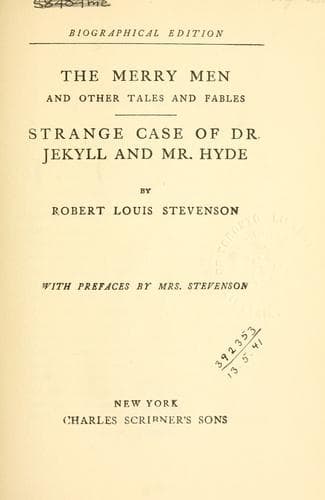
The Merry Men, and Other Tales and FablesStevenson, Robert Louis
History
The Merry Men, and Other Tales and Fables
Stevenson, Robert Louis
Boys -- Fiction; Great Britain -- History -- 19th century -- Fiction; Paranormal fiction; Treasure troves -- Fiction
“Henri,” she said, shaking her head, “you are a man; you cannot
understand my feelings; no woman could shake off the memory of so
public a humiliation.” The Doctor could not restrain a titter. “Pardon
me, darling,” he said; “but really, to the philosophical intelligence,
the incident appears so small a trifle. You looked extremely well—”
“Henri!” she cried.
“Well, well, I will say no more,” he replied. “Though, to be sure, if
you had consented to indue—_À propos_,” he broke off, “and my trousers!
They are lying in the snow—my favourite trousers!” And he dashed in
quest of Jean-Marie.
Two hours afterwards the boy returned to the inn with a spade under one
arm and a curious sop of clothing under the other.
The Doctor ruefully took it in his hands. “They have been!” he said.
“Their tense is past. Excellent pantaloons, you are no more! Stay,
something in the pocket,” and he produced a piece of paper. “A letter!
ay, now I mind me; it was received on the morning of the gale, when I
was absorbed in delicate investigations. It is still legible. From
poor, dear Casimir! It is as well,” he chuckled, “that I have educated
him to patience. Poor Casimir and his correspondence—his infinitesimal,
timorous, idiotic correspondence!”
He had by this time cautiously unfolded the wet letter; but, as he bent
himself to decipher the writing, a cloud descended on his brow.
“_Bigre_!” he cried, with a galvanic start.
And then the letter was whipped into the fire, and the Doctor’s cap was
on his head in the turn of a hand.
“Ten minutes! I can catch it, if I run,” he cried. “It is always late.
I go to Paris. I shall telegraph.”
“Henri! what is wrong?” cried his wife.
“Ottoman Bonds!” came from the disappearing Doctor; and Anastasie and
Jean-Marie were left face to face with the wet trousers. Desprez had
gone to Paris, for the second time in seven years; he had gone to Paris
with a pair of wooden shoes, a knitted spencer, a black blouse, a
country nightcap, and twenty francs in his pocket. The fall of the
house was but a secondary marvel; the whole world might have fallen and
scarce left his family more petrified.
CHAPTER VIII.
THE WAGES OF PHILOSOPHY.
On the morning of the next day, the Doctor, a mere spectre of himself,
was brought back in the custody of Casimir. They found Anastasie and
the boy sitting together by the fire; and Desprez, who had exchanged
his toilette for a ready-made rig-out of poor materials, waved his hand
as he entered, and sank speechless on the nearest chair. Madame turned
direct to Casimir.
“What is wrong?” she cried.
“Well,” replied Casimir, “what have I told you all along? It has come.
It is a clean shave, this time; so you may as well bear up and make the
best of it. House down, too, eh? Bad luck, upon my soul.”
“Are we—are we—ruined?” she gasped.
The Doctor stretched out his arms to her. “Ruined,” he replied, “you
are ruined by your sinister husband.”
Public-domain text, read in full here on John Shaqi.
Reviews
Reviews
No reviews yet
Be the first to share your thoughts on this work.
Elsewhere in the archive
Join the Discussion
Join the discussion
Sign in to leave a comment or review.
Sign InorCreate an account