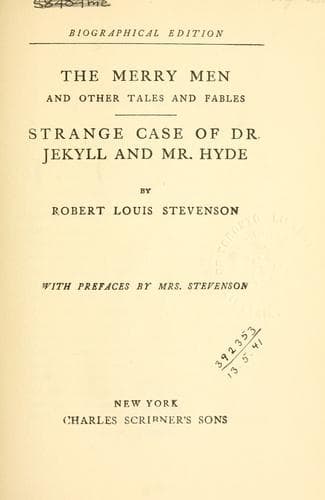
The Merry Men, and Other Tales and FablesStevenson, Robert Louis
History
The Merry Men, and Other Tales and Fables
Stevenson, Robert Louis
Boys -- Fiction; Great Britain -- History -- 19th century -- Fiction; Paranormal fiction; Treasure troves -- Fiction
Casimir observed the consequent embrace through his eyeglass; then he
turned to Jean-Marie. “You hear?” he said. “They are ruined; no more
pickings, no more house, no more fat cutlets. It strikes me, my friend,
that you had best be packing; the present speculation is about worked
out.” And he nodded to him meaningly.
“Never!” cried Desprez, springing up. “Jean-Marie, if you prefer to
leave me, now that I am poor, you can go; you shall receive your
hundred francs, if so much remains to me. But if you will consent to
stay”—the Doctor wept a little—“Casimir offers me a place—as clerk,” he
resumed. “The emoluments are slender, but they will be enough for
three. It is too much already to have lost my fortune; must I lose my
son?”
Jean-Marie sobbed bitterly, but without a word.
“I don’t like boys who cry,” observed Casimir. “This one is always
crying. Here! you clear out of this for a little; I have business with
your master and mistress, and these domestic feelings may be settled
after I am gone. March!” and he held the door open.
Jean-Marie slunk out, like a detected thief.
By twelve they were all at table but Jean-Marie.
“Hey?” said Casimir. “Gone, you see. Took the hint at once.”
“I do not, I confess,” said Desprez, “I do not seek to excuse his
absence. It speaks a want of heart that disappoints me sorely.”
“Want of manners,” corrected Casimir. “Heart, he never had. Why,
Desprez, for a clever fellow, you are the most gullible mortal in
creation. Your ignorance of human nature and human business is beyond
belief. You are swindled by heathen Turks, swindled by vagabond
children, swindled right and left, upstairs and downstairs. I think it
must be your imagination. I thank my stars I have none.”
“Pardon me,” replied Desprez, still humbly, but with a return of spirit
at sight of a distinction to be drawn; “pardon me, Casimir. You
possess, even to an eminent degree, the commercial imagination. It was
the lack of that in me—it appears it is my weak point—that has led to
these repeated shocks. By the commercial imagination the financier
forecasts the destiny of his investments, marks the falling house—”
“Egad,” interrupted Casimir: “our friend the stable-boy appears to have
his share of it.”
The Doctor was silenced; and the meal was continued and finished
principally to the tune of the brother-in-law’s not very consolatory
conversation. He entirely ignored the two young English painters,
turning a blind eyeglass to their salutations, and continuing his
remarks as if he were alone in the bosom of his family; and with every
second word he ripped another stitch out of the air balloon of
Desprez’s vanity. By the time coffee was over the poor Doctor was as
limp as a napkin.
“Let us go and see the ruins,” said Casimir.
Public-domain text, read in full here on John Shaqi.
Reviews
Reviews
No reviews yet
Be the first to share your thoughts on this work.
Elsewhere in the archive
Join the Discussion
Join the discussion
Sign in to leave a comment or review.
Sign InorCreate an account