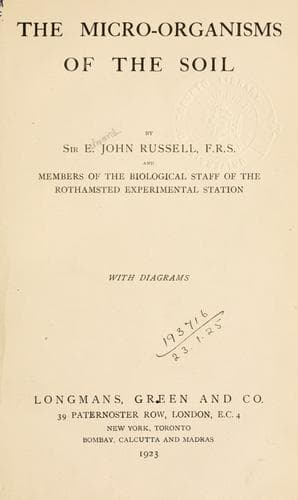
The micro-organisms of the soilRussell, Edward J. (Edward John)
Science
The micro-organisms of the soil
Russell, Edward J. (Edward John)
Soil microbiology
The second primary nitrogen relationship that we have to consider is
the process of ammonification. The ammonifying power of soil fungi was
first demonstrated by Muntz and Coudon,[46] and by Marchal[40] in 1893,
the former showing that _Mucor racemosus_ and _Fusarium Muntzii_ gave a
larger accumulation of ammonia in soil than any of the bacteria tested;
and the latter that _Aspergillus terricola_, _Cephalothecium roseum_
and other soil fungi were active ammonifiers, especially in acid
soils. Shibata,[62] Perotti,[49] Hagem,[26] Kappen,[31] Löhnis,[39]
and others, have observed that urea, dicyanamide and cyanamide are
decomposed with the liberation of ammonia; and Hagem[26] has recorded
the same process for peptones, amino acids, and other organic nitrogen
compounds in plant and animal remains in the soil. The latter author
considers soil fungi more important ammonifying agents in the soil than
bacteria, a conclusion in which McLean and Wilson,[44] and perhaps most
later workers concur. McLean and Wilson[44] found large differences in
the ammonifying powers of various soil fungi, the _Moniliaceæ_ being
the strongest ammonifiers, the _Aspergillaceæ_ the weakest. Generic and
specific differences have been confirmed by Coleman,[15] Waksman,[67]
and other authors. Waksman and Cook[70] suggested that such variations
may be due, not to innate differences in the metabolic activities of
the several organisms, but to differences in reproductive times, and
that there might be some relationship between sporogeny and the ability
to accumulate nitrogen. Kopeloff[35] has carried out experiments on
the inoculation of sterilised soil with known quantities of spores
and found that, although the amount of ammonia accumulated increased
with the number of spores the proportion was not direct but modified
by the food supply. After the first five days’ growth, the rate of
ammonia production varied markedly in a two-day rhythm which seemed
to be due to the metabolism of the fungus rather than to recurrent
stages of spore formation and germination in the life history. The
amount of ammonia liberated has been shown by recent work[66] to depend
upon the available sources of carbon and nitrogen. In the absence of
a carbohydrate supply the protein is attacked both for carbon and
nitrogen, and since more of the former is required much ammonia is
liberated. In addition, however, to the carbon and nitrogen control,
the process of ammonification by soil fungi is intimately related to
physical conditions. Working with pure cultures, McLean and Wilson,[44]
Coleman,[15] Kopeloff,[35] Waksman and Cook,[70] and other students,
have shown that the amount of ammonia accumulated depends upon such
factors as the presence of phosphates, the period of incubation of the
fungi, aeration, the moisture in the soil, the temperature, the degree
of soil acidity, the type of soil, and so forth.
Public-domain text, read in full here on John Shaqi.
Reviews
Reviews
No reviews yet
Be the first to share your thoughts on this work.
Elsewhere in the archive
Join the Discussion
Join the discussion
Sign in to leave a comment or review.
Sign InorCreate an account