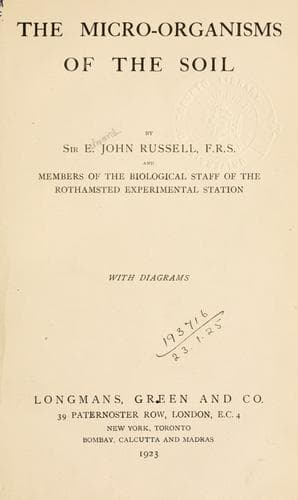
The micro-organisms of the soilRussell, Edward J. (Edward John)
Science
The micro-organisms of the soil
Russell, Edward J. (Edward John)
Soil microbiology
That fungi take a very important place as ammonifying agents in the
soil can no longer be doubted, but the question yet remains to be
considered of the balance of profit or loss resulting from their
activities. It has usually been considered that a part of the ammonia
freed is used by the fungi themselves, but that the greater part
is liberated, and so rendered available to nitrifying organisms.
Both Neller[47] and Potter and Snyder[51] found that typical soil
fungi inoculated into sterile soil grew with a vigour approximately
equal to the growth induced by an inoculation of the entire soil
flora. This is largely to be accounted for by the fact that when
soils are sterilised by heat or by certain chemicals, breaking-down
changes occur, and substances are liberated which are peculiarly
favourable to fungus growth. This fact must be borne in mind when
interpreting ammonification and other studies where the method is that
of inoculation of fungi into sterilised soil. In many cases it tends
to nullify any application of the results to normal soils, whilst in
others the conclusions must be accepted with some reserve. In all
cases Potter and Snyder[51] found that fungi caused a diminution in
the amount of nitrates, that the ammonia was not much changed in
amount, and that there was a decrease in the quantities of soluble
non-protein nitrogen. The range of organic and inorganic nitrogenous
compounds utilisable by soil fungi is very great. Ritter[56] has shown
that certain forms can use the nitrogen of “free” nitric acid in the
medium; Ritter,[56] Hagem,[26] and others, that soil fungi can use
ammonia nitrogen equally with nitrate nitrogen, and Ehrenberg[21]
concluded that soil fungi play a more important part in the building
of albuminoids from ammonia than bacteria do. Ehrlich[22] has shown
that various heterocyclic nitrogen compounds and alkaloids can serve as
sources of nitrogen to soil fungi, whilst Ehrlich and Jacobsen[23] have
found that soil fungi can form oxy-acids from amino-acids. Hagem,[26]
Povah,[52] Bokorny,[6],[8] and others, state that for many soil forms
organic nitrogen sources are better than inorganic sources, and that
peptones, amino-acids, urea, and uric acids, etc., are very quickly
utilised by species of _Mucor_, yeasts, and so forth. Butkevitch,[12]
and Dox[18] have recently found that it depends on circumstances which
compounds of protein molecule can be utilised by particular fungi, and
that soil fungi can utilise both amino and amido complexes for the
formation of ammonia. In 1919 Boas[4] showed for _Aspergillus niger_
that if a number of nitrogenous compounds are available the fungus
absorbs the most highly dissociated.
Public-domain text, read in full here on John Shaqi.
Reviews
Reviews
No reviews yet
Be the first to share your thoughts on this work.
Elsewhere in the archive
Join the Discussion
Join the discussion
Sign in to leave a comment or review.
Sign InorCreate an account