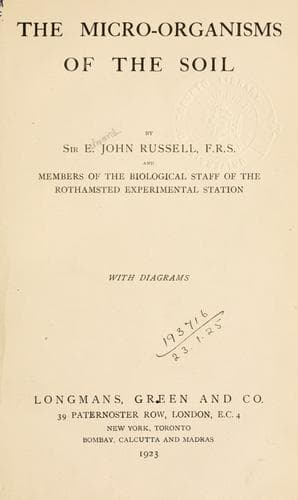
The micro-organisms of the soilRussell, Edward J. (Edward John)
Science
The micro-organisms of the soil
Russell, Edward J. (Edward John)
Soil microbiology
In all such work, however, one must bear acutely in mind the
fact that a sterilised soil and, still more, an artificial soil, is a
very different complex from a normal soil, and that results obtained
from the inoculation of such soils are not applicable directly in the
elucidation of ordinary soil processes. At present there is no method
known of completely sterilising a soil which does not destroy the
original physico-chemical balance. It is evident that the complexities
are such that chemist, physicist, and biologist must all co-operate
if the significance of the processes is to be understood, and a solid
foundation laid for future progress and for practical application.
[1] Appel, O., “Untersuchungen über die Gattung _Fusarium_,” Mitt.
Biol. Reichanst. Land- u. Forstw., 1907, 4.
[2] Bernard, N., “L’évolution dans la symbiose. Les Orchidées et
leurs Champignons commensaux,” Ann. Sci. Nat. (Bot.), Ser. 9, 1909, 9.
[3] Bewley, W. F., “Anthracnose of the cucumber under glass,” Journ.
Min. Agric., 1922, xxix.
[4] Boas, F., “Die Bildung löslicher Stärke im elektiven
Stickstoff-Stoffwechsel,” Ber. deut. bot. Ges., 1919, 37.
[5] Boas, F., und Leberle, H., “Untersuchungen über Säurenbildung bei
Pilzen und Hefen II.,” Biochem. Ztschr., 1918, 92.
[6] Bokorny, T., “Benzene derivatives as sources of nourishment,”
Zentr. Physiol., 1917, 32.
[7] Bokorny, T., “Sugar fermentation and assimilation,” Allg. Brau.
Hopfen Zeit., 1917, 57.
[8] Bokorny, T., “Verhaltung einiger organischer Verbindungen in der
lebenden Zelle,” Pflügers Archiv., 1917, 168.
[9] Brown, P. E., “Mould action in soils,” Science, 1917, 46.
[10] Burgeff, H., “Die Wurzelpilze der Orchideen,” Jena. 1909.
[11] Bussey, W., Peters, L., and Ulrich, P., “Ueber das Vorkommen
von Wurzelbranderregern im Boden,” Arb. Kais. Biol. Anst. Land- u.
Forstw., 1911, 8.
[12] Butkevitch, V. S., “Ammonia as a product of protein
transformations caused by mould fungi, and the conditions of its
formation,” Recueil d’articles dedié au Prof. C. Timiriazeff, 1916.
[13] Butler, E. J., “An account of the genus _Pythium_ and some
_Chytridiaceæ_,” Mem. Dept. Agr. India, 1907, Bot. Ser. 5, 1.
[14] Christoph, H., “Untersuchungen über die mykotrophen Verhältnisse
der Ericales und die Keimung von Pirolaceen,” Beihefte Bot. Centr.,
1921, 28.
[15] Coleman, D. A., “Environmental factors influencing the activity
of soil fungi,” Soil Sci., 1916, 2.
[16] Dascewska, W., “Étude sur la désagrégation de la cellulose dans
la terre de bruyère et la tourbe,” Univ. Genève, Inst. Bot., 1913, S.
8.
[17] De Bruyn, H. L. G., “The saprophytic life of _Phytophthora_ in
the soil,” Meded. v. d. Landbouwhoogeschool Wageningen, 1922, xxiv.
[18] Dox, A. W., “Amino acids and micro-organisms,” Proc. Iowa Acad.
Sci., 1917, 24.
[19] Dox, A. W., and Neidig, R. E., “Pentosans in lower fungi,”
Journ. Biol. Chem., 1911, 9.
Public-domain text, read in full here on John Shaqi.
Reviews
Reviews
No reviews yet
Be the first to share your thoughts on this work.
Elsewhere in the archive
Join the Discussion
Join the discussion
Sign in to leave a comment or review.
Sign InorCreate an account