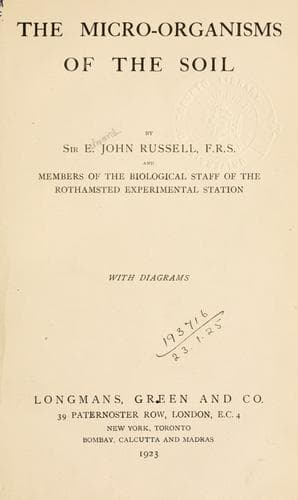
The micro-organisms of the soilRussell, Edward J. (Edward John)
Science
The micro-organisms of the soil
Russell, Edward J. (Edward John)
Soil microbiology
From a general survey of the researches that have been carried out on
soil fungi during the past two decades certain issues emerge. It would
seem clear that fungi occupy, perhaps, a primary place as factors in
the decomposition of celluloses, and thus may be the chief agents in
the transformation of plant remains to humus and to soluble compounds
which can be used as food by the nitrogen-fixing bacteria. Furthermore,
soil fungi are very important ammonifiers, but whether the balance
of ammonia freed is utilised by the fungi themselves, or whether it
is made available to nitrifying bacteria is not yet clear. If the
latter is the case, soil fungi play a valuable indirect rôle in the
accumulation of available plant food in the soil. On the other hand, by
utilising nitrates as sources of nitrogen, fungi may play an important
part in the depletion of the nitrogenous food in the soil available to
crop plants. Thirdly, soil fungi apparently take no part in the direct
nitrogen enrichment of the soil. Thus, soil fungi would seem to be the
most important factor in the first half of that great cycle whereby
organic remains become again available as organic food.
The impression left on one’s mind by the study of the life of fungi
in the soil is of an infinitely complex series of moving equilibria,
the living activities being determined by both biological and
physico-chemical conditions. All these factors play an integral part in
the life of the soil fungi and must be considered if a true picture is
to be drawn. The principal factors may be classified into the following
groups: Most evident, perhaps, are the natures and specificities of
the fungi and the relative composition of the fungus flora. Equally
important, however, are the quantity and quality of the foods available
and the non-biological environment which results from the complex
series of physical and chemical changes occurring in the soil causally
independent of the organisms present, which interacts with the equally
vast series of changes resulting from fungus activities. Finally, one
must consider the interacting biological environment of surface animals
and plants and the microscopic fauna and flora. The complexities are
such that only the application of Baconian principles can unravel
them. A beginning has been made in the study of pure cultures of soil
fungi on synthetic media, and much valuable data have accrued, but
it is obviously not possible to apply directly to soil the results
obtained in such work. They remain possibilities; in certain cases
probabilities, but nothing more. A further step, one already taken
and of great promise, is the investigation of the changes occurring
in sterilised soils inoculated with known quantities of one or more
pure cultures of particular soil fungi. Such intensive study of single
factors in a standardised natural or artificial soil, to which has been
added a pedigreed fungus, is, perhaps, the most fruitful avenue of
progress.
Public-domain text, read in full here on John Shaqi.
Reviews
Reviews
No reviews yet
Be the first to share your thoughts on this work.
Elsewhere in the archive
Join the Discussion
Join the discussion
Sign in to leave a comment or review.
Sign InorCreate an account