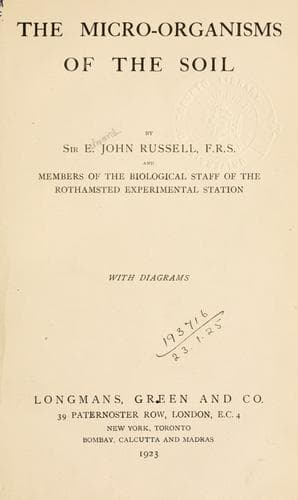
The micro-organisms of the soilRussell, Edward J. (Edward John)
Science
The micro-organisms of the soil
Russell, Edward J. (Edward John)
Soil microbiology
[65] Waksman, S. A., “Soil fungi and their activities,” Soil Sci.,
1916, 2.
[66] Waksman, S. A., “The influence of available carbohydrate upon
ammonia accumulation by micro-organisms,” Journ. Amer. Chem. Soc.,
1917, 39.
[67] Waksman, S. A., “Proteolytic enzymes of soil fungi and
_Actinomycetes_,” Journ. Bact., 1918, 3.
[68] Waksman, S. A., “On the metabolism of _Actinomycetes_,” Proc.
Soc. Amer. Bact. Abstract Bact., 1919, 3.
[69] Waksman, S. A., “The influence of soil reaction upon the growth
of _Actinomycetes_ causing potato scab,” Soil Sci., 1922, xiv.
[70] Waksman, S. A., and Cook, R. C., “Incubation studies with soil
fungi,” Soil Sci., 1916, 1.
CHAPTER IX.
THE INVERTEBRATE FAUNA OF THE SOIL (OTHER THAN PROTOZOA).
The micro-organisms of the soil have been fully discussed in the
preceding chapters of this volume. There now remains to be considered
the fauna of invertebrate animals, other than protozoa, which inhabit
that same medium. In the first place, it is necessary to define what
groups of invertebrate animals are to be regarded as coming under the
category of soil organisms. The latter expression has rather a wide
application and, for the present purpose, is held to mean any organism
of its kind which, in some stage or stages of its life-cycle, lives
on or below the surface of the soil. It will be obvious that, with so
comprehensive a definition, the intimacy of the association of these
animals with the soil will vary within very wide limits. Some animals
pass their whole life-cycle in the soil; others are only present during
a limited phase, and not necessarily in a trophic condition, but since
their occurrence is constant, they cannot be entirely omitted from
consideration.
Unlike the groups of organisms which have been dealt with in the
foregoing pages, the invertebrates of the soil do not admit, as a rule,
of investigation in culture media. It is, in consequence, much more
difficult to achieve in the laboratory the same control over their
environmental conditions. This fact in itself largely explains why
the interpretations of field observations in animal ecology have not
usually been subjected to the test of laboratory experimentation. The
study of animal ecology, in so far as the denizens of the soil are
concerned, is of very recent birth. It has not, as yet, passed the
preliminary stage of cataloguing empirical data, and much spade work
will be necessary before the various factors controlling the phenomena
actually observed are understood.
Owing to the paucity of information available, this chapter is
essentially based upon observations conducted at Rothamsted. Its object
is not so much to attempt to evaluate the invertebrate fauna of the
soil, as to suggest a line of ecological work demanding investigation
on land of many different types.
METHOD OF INVESTIGATING THE SOIL FAUNA.
Public-domain text, read in full here on John Shaqi.
Reviews
Reviews
No reviews yet
Be the first to share your thoughts on this work.
Elsewhere in the archive
Join the Discussion
Join the discussion
Sign in to leave a comment or review.
Sign InorCreate an account