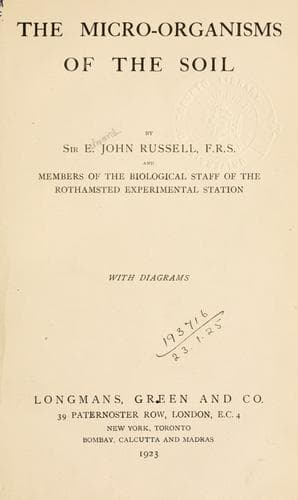
The micro-organisms of the soilRussell, Edward J. (Edward John)
Science
The micro-organisms of the soil
Russell, Edward J. (Edward John)
Soil microbiology
The method adopted at Rothamsted consists in taking weekly soil samples
from a given area for a period of twelve months. Each sample is a cube
of soil, with a side dimension of nine inches, and a total content
of 729 cubic inches. The samples are taken by means of an apparatus
consisting of four iron plates, which are driven into the ground down
to the required depth so as to form a kind of box, which encloses a
cube of soil (_vide_ Morris, 1922 A). The latter is then removed in
layers, each layer being transferred to a separate bag for the purpose.
When the complete sample has been extracted, there are five bags
containing layers of soil taken from the surface to a depth of 1″, from
1″ to 3″, from 3″ to 5″, from 5″ to 7″, and 7″ to 9″ respectively.
Below a depth of 9″ no samples have been taken.
The sample obtained in this manner may be gradually worked into small
fragments by hand, and examined whenever necessary under a binocular
microscope for the smaller organisms present. This procedure, however,
is very tedious and has been replaced by the use of an apparatus
consisting of a series of three sieves, with meshes of decreasing size
(_vide_ Morris, 1922). The soil is washed through these sieves by means
of a stream of water, and the meshes of the final strainer are small
enough to retain all except the most minute organisms present, while at
the same time they allow the finest soil particles to be carried away.
When desirable, the effluent can be passed through a bag or sieve of
bolting silk, in order to collect such organisms that may have passed
through the third sieve.
In addition to the actual taking and examination of the samples, a
botanical survey of the area under investigation is made; chemical
and mechanical analyses of the soil are also required. It is further
necessary to take soil temperature readings, to determine the moisture
content of the samples taken, and the amount of organic matter which
they contain.
GROUPS OF INVERTEBRATA REPRESENTED IN THE SOIL.
The various groups of invertebrates represented in the soil may be
briefly referred to in zoological order.
_Nematoda._--The Nematoda or thread-worms are chiefly animal parasites,
nevertheless they usually lead an independent existence in the soil
in certain stages of their development. The numerous small species
belonging to the family _Anguillididæ_, or eel-worms, form a definite
constituent of the soil fauna; they are generally free-living and
non-parasitic. Certain members of this family, however, are enemies of
cultivated plants.
_Annelida._--Terrestrial Annelida are almost entirely confined to the
order _Oligochæta_, the majority of which are earthworms (_Terricolæ_),
whose whole life-cycle is passed within the confines of the soil.
The small white worms of the family _Enchytræidæ_ belong to the
aquatic section (_Limicolæ_) of the order, but they have various
representatives which are abundant in damp soil containing organic
matter.
Public-domain text, read in full here on John Shaqi.
Reviews
Reviews
No reviews yet
Be the first to share your thoughts on this work.
Elsewhere in the archive
Join the Discussion
Join the discussion
Sign in to leave a comment or review.
Sign InorCreate an account