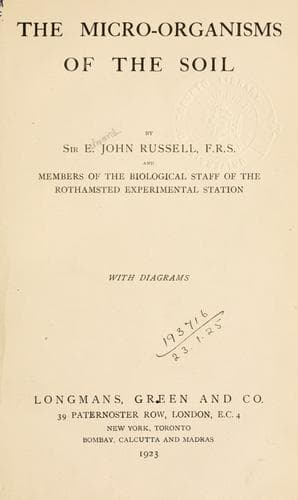
The micro-organisms of the soilRussell, Edward J. (Edward John)
Science
The micro-organisms of the soil
Russell, Edward J. (Edward John)
Soil microbiology
_Mollusca._--The terrestrial Mollusca are included in the sub-order
_Pulmonata_ of the _Gastropoda_. These organisms, which include the
snails (_Helicidæ_) and slugs (_Limacidæ_), regularly deposit their
eggs in moist earth. Slugs adopt the soil as a frequent habitat, only
leaving it for feeding purposes in the presence of sufficient moisture.
They are frequent consumers of vegetation, with the exception of
_Testacella_, which is carnivorous.
_Crustacea._--The few species of Crustacea inhabiting the soil belong
to the order _Isopoda_, family _Oniscidæ_, which are popularly referred
to as “woodlice,” “slaters,” etc.
_Myriapoda._--The _Diplopoda_ or millipedes include enemies of
various crops and are common denizens of the soil. The _Chilopoda_ or
centipedes are usually less abundant and are carnivorous. The minute
_Symphyla_ are often evident but are of minor importance.
_Insecta._--Insects form the dominant element in the invertebrate
fauna. Phytophagous species devour the subterranean parts of plants,
and notable examples are afforded by the larvæ of _Melolontha_,
_Agriotes_ and _Tipula_. Saprophagous forms are abundantly represented
by the _Collembola_, and by numerous larval _Diptera_ and _Coleoptera_.
Predaceous species preying upon other members of the soil fauna
are exemplified by the _Carabidæ_ and many larval _Diptera_.
Parasitic species pass their larval stages on or within the bodies
of other organisms. The groups of _Hymenoptera_, and the dipterous
family _Tachinidæ_, which exhibit this habit, constitute, along
with predaceous forms, one of the most important natural agencies
controlling the multiplication of insect life. There are also insects
(ants, and other of the aculeate _Hymenoptera_) which utilize the
soil as a suitable medium wherein to construct their habitations or
brood chambers, without necessarily deriving their food from the soil.
Lastly, there are many insects, notably _Lepidoptera_, which only
resort to the soil for the purpose of undergoing pupation. The insect
fauna is, therefore, a closely inter-connected biological complex; for
a discussion and an enumeration of its representatives reference may be
made to papers by Cameron (1913, 1917), and Morris (1921, 1922 a).
_Arachnida._--The two principal classes represented in the soil are the
_Areinida_, or spiders, and the _Acarina_, or mites, and ticks. The
_Areinida_, which are well-known to be carnivorous, are an unimportant
constituent of the fauna. _Acarina_, on the other hand, are abundant,
and exhibit a wide range of feeding habits; most of the soil forms are
probably carnivorous, and either free-living or parasitic.
NUMBER OF ORGANISMS PRESENT AND THEIR DISTRIBUTION IN DEPTH.
Public-domain text, read in full here on John Shaqi.
Reviews
Reviews
No reviews yet
Be the first to share your thoughts on this work.
Elsewhere in the archive
Join the Discussion
Join the discussion
Sign in to leave a comment or review.
Sign InorCreate an account