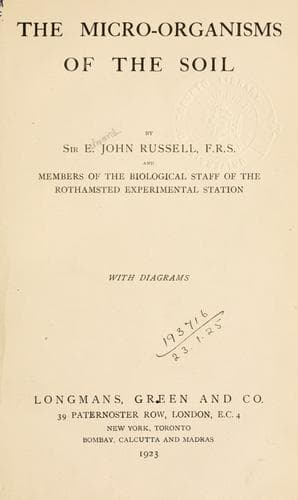
The micro-organisms of the soilRussell, Edward J. (Edward John)
Science
The micro-organisms of the soil
Russell, Edward J. (Edward John)
Soil microbiology
(_b_) In their relation to the nitrogen cycle (_vide_ p. 174), the
activities of the soil invertebrates may be expressed diagrammatically,
as a side-chain in the process (Fig. 23). The proteins, elaborated by
plants, are utilised as nitrogenous food by the phytophagous animals
present. The waste products of the latter, which contain the nitrogen
not used for growth or the replacement of loss by wear and tear, are
returned to the soil. Here they disintegrate, and are ultimately
converted into ammonium salts, mainly by bacterial action. The dead
bodies of these animals are also broken down by various means, becoming
eventually chemically dissociated and available as plant food. Animal
(and plant) residues serve, however, as food for the large number of
saprophagous invertebrates present in the soil. In this event the
nitrogen contained in such residues becomes “locked up,” as it were,
for the time being in their bodies. Both saprophagous and phytophagous
animals are preyed upon by carnivorous species, but ultimately the
nitrogen is returned to the soil upon the death of those organisms.
The amount present in the bodies of the whole invertebrate fauna has
been calculated by Morris (1922) upon analyses furnished by chemists
at Rothamsted. It is estimated that the fauna of manured land contains
about 7349 grm., or 16·2 lb. of nitrogen per acre, and that of
untreated land, 3490 grm., or 7·5 lb. per acre. These amounts are equal
respectively to the nitrogen content of 103·6 lb. and 48 lb. of nitrate
of soda.
The primary question affecting agriculture is, whether any notable
loss of nitrogen is occasioned by the presence of these organisms in
the soil. It has been mentioned that their nitrogenous waste material,
and their dead bodies, ultimately undergo disintegration; any loss,
if any, takes place during the latter process. With the more complex
compounds it probably consists in the production of amino-acids and
their subsequent hydrolysis or oxidation. During this process an
appreciable loss of nitrogen in the gaseous form occurs. This loss,
which is discussed on p. 173 would represent the net deficit occasioned
by the incidence of invertebrates in the soil. Against this loss must
be placed the beneficial action of such organisms as earthworms, which,
in all probability, more than counterbalances it.
(_c_) Many soil insects, on account of their phytophagous habits, are
well-known to be some of the most serious enemies of agriculture.
Certain of these, and also other classes of invertebrates, which are
likewise directly injurious, have been instanced in the earlier pages
of this chapter. Detailed information on this subject will be found in
textbooks of economic zoology, notably the volume by Reh (1913).
LITERATURE REFERRED TO.
ADAMS, C. C., “An Ecological Study of Prairie and Forest
Invertebrates,” Bull. Illin. St. Lab. Nat. Hist., 1915, xi.
Public-domain text, read in full here on John Shaqi.
Reviews
Reviews
No reviews yet
Be the first to share your thoughts on this work.
Elsewhere in the archive
Join the Discussion
Join the discussion
Sign in to leave a comment or review.
Sign InorCreate an account