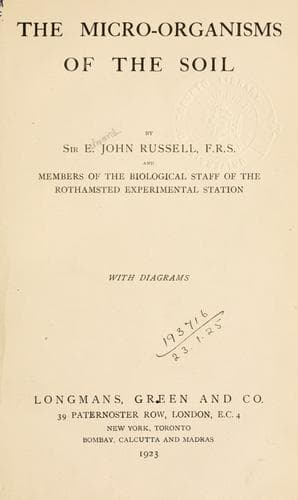
The micro-organisms of the soilRussell, Edward J. (Edward John)
Science
The micro-organisms of the soil
Russell, Edward J. (Edward John)
Soil microbiology
CAMERON, A. E., “General Survey of the Insect Fauna of the Soil,”
Journ. Econ. Biol., 1913, viii. “Insect Association of a Local
Environmental Complex in the District of Holmes Chapel, Cheshire,”
Trans. Roy. Soc. Edin., 1917, lii.
DARWIN, C., “Vegetable Mould and Earthworms,” London, 1881.
HAMILTON, C. C., “The Behaviour of some Soil Insects in Gradients of
Evaporating Power of Air, etc.,” Biol. Bull., 1917, xxxii.
MORRIS, H. M., “Observations on the Insect Fauna of Permanent Pasture
in Cheshire,” Ann. App. Biol., 1921, vii. “On a Method of Separating
Insects and other Arthropods from Soil,” Bull. Entom. Res., 1922,
xiii. “The Insect and Other Invertebrate Fauna of Arable Land at
Rothamsted,” Ann. App. Biol., 1922 A, ix.
REH, L., In Sorauer’s “Pflanzenkrankheiten,” 1913, iii.
RICHARDSON, C. H., “The Attraction of Diptera to Ammonia,” Ann. Ent.
Soc. Amer., 1916, ix.
RUSSELL, E. J., “The Effect of Earthworms on Soil Productiveness,”
Journ. Agric. Sci., 1910, iii.
SHELFORD, V. E., “Animal Communities in Temperate America,” Chicago.
1914, “The Importance of the Measure of Evaporation in Economic
Studies of Insects,” Journ. Econ. Entom., 1912, vii.
CHAPTER X.
THE CHEMICAL ACTIVITIES OF THE SOIL POPULATION AND THEIR RELATION TO
THE GROWING PLANT.
In the preceding chapters it is shown that the soil is normally
inhabited by a very mixed population of organisms, varying in size from
the smallest bacteria up to nematodes and others just visible to the
unaided eye, on to larger animals, and finally earthworms, which can
be readily seen and handled. These organisms all live in the soil, and
therefore must find in it the conditions necessary for their growth.
We have dealt in the first chapter with the supplies of water, air,
and heat, without which life is clearly impossible. Equally necessary
is the source of energy, for the organism requires energy material as
surely as the motor engine requires petrol, and it ceases to function
unless an adequate supply is forthcoming.
All the energy comes in the first instance from the sun, if we exclude
the unknown but probably small fraction coming from radio-active
elements. But this radiant energy is not utilisable by the soil
population, excepting surface algæ; it has to be transformed into
another kind. So far, chlorophyll is the only known transformer;
it fixes the energy of sunlight and stores it up in bodies like
hemicellulose, sugar, starch, protein, etc. The transformation is
imperfect; even the heaviest yielding crops grown under glass, in
conditions made as favourable as our knowledge permits, utilise only
about 4 per cent. of the total energy available during their period of
growth; in natural conditions not more than 0·4 per cent. is utilised.
Such as it is, however, the energy fixed in the plant represents all,
indeed more than all, that the soil organisms can obtain.
Public-domain text, read in full here on John Shaqi.
Reviews
Reviews
No reviews yet
Be the first to share your thoughts on this work.
Elsewhere in the archive
Join the Discussion
Join the discussion
Sign in to leave a comment or review.
Sign InorCreate an account