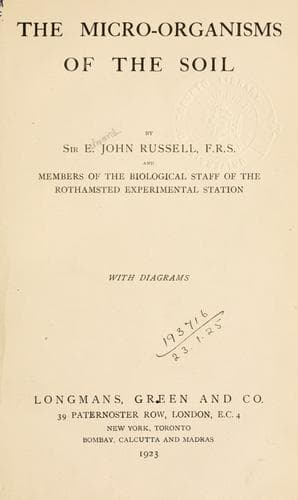
The micro-organisms of the soilRussell, Edward J. (Edward John)
Science
The micro-organisms of the soil
Russell, Edward J. (Edward John)
Soil microbiology
The outside value for the amount of energy fixed in the soil is
obtainable by combustion of the soil in a calorimeter, but much of
this is not available to the soil organisms. The normal sedimentary
soils of England still contain decomposition products of the débris
of plants and animals originally deposited with them, but in the long
course of ages much of the extractable energy has been utilised. The
soil population is thus dependent on recently grown vegetation, and it
is therefore largely confined to the layer, usually in this country
about 6 inches thick, through which the recently dead vegetation is
distributed. Below this level there may be sufficient air, water,
temperature, etc., but there is insufficient source of energy for any
large population.
Unfortunately there is no ready means for distinguishing between the
total and the actually available quantity of energy in the soil. But
it is not difficult, by adopting the Rothamsted analytical method, to
ascertain the approximate amount of energy that has been transformed in
a given period. The Rothamsted plots are periodically analysed and a
balance sheet is drawn up showing how much of each constituent has been
added to and removed from the soil in the intervening period. For two
of the Broadbalk plots the results are shown in Tables XV., XVI.
The dunged plot receives 14 tons farmyard manure per annum, a quantity
in excess of what would usually be given; the unmanured plot, on the
other hand, has received no manure for many years and is abnormally
poor. Normal soils lie somewhere between these limits, but tending
rather to the value for the dunged than for the unmanured plot. It will
be seen that each acre of the dunged land loses on an average 41,000
calories per day, while each acre of the unmanured land loses on an
average 2700 calories per day.
TABLE XV.--MATERIAL BALANCE SHEET: BROADBALK SOIL, ROTHAMSTED.
(LB. PER ACRE PER ANNUM.)
+-------------------------+-------------+---------------+
| | Farmyard | No Manure |
| |Manure Added.| Added. |
| +------+------+-------+-------+
| | C. | N. | C. | N. |
+-------------------------+------+------+-------+-------+
|Added in farmyard manure| 3600 | 200 | nil | nil |
|Added in stubble | 300 | 3 | 100 | 1 |
+-------------------------+------+------+-------+-------+
| Total added | 3900 | 203 | 100 | 1 |
|Taken from soil | nil | nil | 200 | nil |
|Stored in soil | 200 | 30 | nil | nil |
+-------------------------+------+------+-------+-------+
| Lost from soil | 3700 | 170 | 300 | nil[H]|
| Per cent. | 95 | 84 | 100 | nil |
+-------------------------+------+------+-------+-------+
Initial C : N ratio in farmyard manure, 18 : 1
Final C : N ratio in soil, 10 : 1.
Public-domain text, read in full here on John Shaqi.
Reviews
Reviews
No reviews yet
Be the first to share your thoughts on this work.
Elsewhere in the archive
Join the Discussion
Join the discussion
Sign in to leave a comment or review.
Sign InorCreate an account