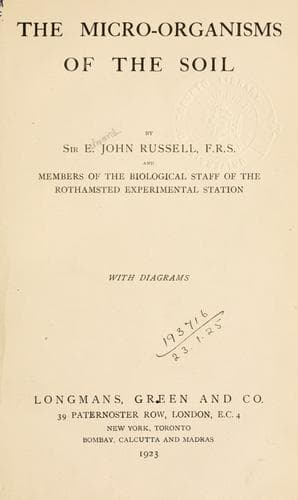
The micro-organisms of the soilRussell, Edward J. (Edward John)
Science
The micro-organisms of the soil
Russell, Edward J. (Edward John)
Soil microbiology
In the state of Nature, vegetation dies and is left on the soil. Two
things may then happen. It may become drawn into the soil by earthworms
and other agents; the energy supply is thus distributed in the soil
to serve the needs of the varied soil population. This is the normal
case, associated with the normal soil population and the normal flora.
If, however, the mingling agents are absent, the dead vegetation lies
like a mat on the surface of the soil, only partially decomposing,
unsuitable for the growth of most seedlings, and effectually preventing
most of the vegetation below from pushing a way through: thus there
comes to be no vegetation at all, or only a very restricted and special
flora. The soil population becomes also specialised. Peats and acid
grassland afford examples.
On the neutral grass plots at Rothamsted, the dead vegetation does not
accumulate on the surface but is rapidly decomposed or drawn into the
soil, leaving the surface of the earth bare and free for the growth
of seedlings. On the acid plots dead vegetation remains long on the
surface, blotting out all new growth excepting two or three grasses
which form underground runners capable of penetrating the mat, and
sorrel, the seedling roots of which seem to have the power of boring
through a fibrous layer of this sort. It is possible to remove the
mat entirely by bacterial action alone, if sufficient lime be added
periodically to make the reaction neutral, but failing these repeated
additions the mat persists.
We shall confine ourselves to the normal case where earthworms bring
the source of energy into the soil.
Directly the energy is available, it begins to be utilised. Two laws
govern the change. The first is well-known to biologists: it states
that the total energy of the system remains constant and can neither
be increased nor diminished except from outside; in other words, that
energy can be neither created nor destroyed. The second law is less
familiar: it is that energy once transformed to heat by one organism
cannot be used again by another. It is not destroyed; it remains
intact, but is useless to the organism. One cannot have an indefinite
chain of organisms living on each other’s excretory products; there was
a certain quantity of energy in the food eaten by the first, and no
more than this quantity can be got out whether one organism obtains the
whole or whether others share it.
Public-domain text, read in full here on John Shaqi.
Reviews
Reviews
No reviews yet
Be the first to share your thoughts on this work.
Elsewhere in the archive
Join the Discussion
Join the discussion
Sign in to leave a comment or review.
Sign InorCreate an account