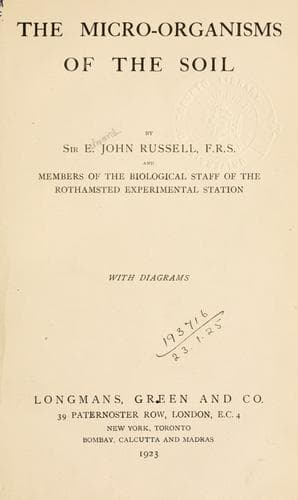
The micro-organisms of the soilRussell, Edward J. (Edward John)
Science
The micro-organisms of the soil
Russell, Edward J. (Edward John)
Soil microbiology
It must be admitted that the evidence is indirect. The rate of
oxidation of ammonia by bacteria in the soil is more rapid than the
rate of formation, so that ammonia is practically never found in the
soil in more than minimal amounts (1 or 2 parts per 1,000,000); indeed,
the only evidence of its formation was for a long time the fact that
no compound other than ammonia could be oxidised by the nitrifying
organism. It has, however, since been shown at Rothamsted that ammonia
accumulates in soils in which the nitrifying organism has been killed.
Nothing is known of the mechanism of the oxidation of ammonia beyond
the fact that it is biological; the reaction is not easily effected
chemically at ordinary temperatures. Possibly the organism assimilates
ammonia at one end of a chain of metabolic processes and excretes
nitrates at the other. Or, the reaction may be simply a straight
oxidation for energy purposes, the ammonia changing to hydroxylamine
and then to nitrous and nitric acids.
The nitrate does not remain long in the soil. Some is taken up by the
plant and some is washed out from the soil. Part, however, either of
the nitrate itself or of one of its precursors is converted into an
insoluble form: probably it is changed into protein by the action of
micro-organisms; it then goes through the whole process once more.
These are the general outlines; they present no particular chemical
difficulties. When we come to details, however, there is much that
cannot be understood.
First of all, there is the slow rate at which complex nitrogen
compounds disappear from the soil in comparison with the rate of
oxidation of the carbon. Thus, in the original plant residues, there
is some forty times as much carbon as nitrogen: before they have been
long in the soil there is only ten times as much carbon as nitrogen;
this seems to be the stable position. What is the reason for this
preferential oxidation of the carbon? No explanation can yet be given.
[Illustration: FIG. 24.
X-axis: 1887-8 1890-1 1900-1 1910-11
Y-axis: ℔ per acre]
An equally difficult problem arises in connection with the length of
time the process will continue. Decomposition of the nitrogen compounds
never seems to be complete in the soil; it dribbles on interminably.
In the year 1870 Lawes and Gilbert cut off a block of soil from its
surroundings and undermined it so that the drainage water could be
collected and analysed. The soil has been kept free from vegetation
or addition of nitrogen compounds from that time till now; yet it has
never failed to yield nitrates, and the annual yield falls off only
very slowly (Fig. 24). This same peculiarity is seen in the yield of
crops on unmanured land: it decreases, but very gradually; even after
eighty years the process is far from complete, and there is no sign
that it will ever come to an end.
TABLE XVII.--APPROXIMATE LOSS OF NITROGEN FROM CULTIVATED SOILS:
BROADBALK WHEAT FIELD, ROTHAMSTED, FORTY-NINE YEARS (1865-1914.)
Public-domain text, read in full here on John Shaqi.
Reviews
Reviews
No reviews yet
Be the first to share your thoughts on this work.
Elsewhere in the archive
Join the Discussion
Join the discussion
Sign in to leave a comment or review.
Sign InorCreate an account