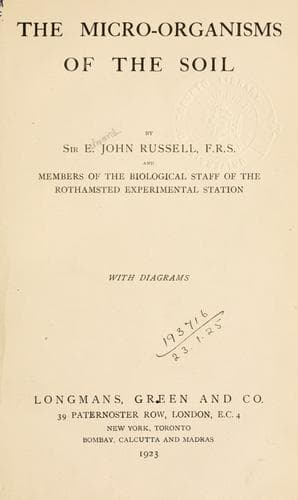
The micro-organisms of the soilRussell, Edward J. (Edward John)
Science
The micro-organisms of the soil
Russell, Edward J. (Edward John)
Soil microbiology
+------------------------+---------------------+---------------------+
| | Rich Soil: Plot 2. | Poor Soil: Plot 3. |
| | Lb. per Acre. | Lb. per Acre. |
+------------------------+---------------------+---------------------+
|Nitrogen in soil in 1865|·175 per cent. = 4340|·105 per cent. = 2720|
|Nitrogen added in | | |
|manure, rain (5 lb. per | | |
|annum), and seed (2 lb. | | |
|per annum) | 10,140 | 340 |
+------------------------+---------------------+---------------------+
|Nitrogen expected in | | |
|1914 | 14,480 | 3060 |
|Nitrogen found in 1914 |·259 per cent. = 5950|·095 per cent. = 2590|
+------------------------+---------------------+---------------------+
|Loss from soil | 8530 | 470 |
|Nitrogen accounted for | | |
|in crops | 2500 | 750 |
+------------------------+---------------------+---------------------+
|Balance, being dead loss| 6030 | -280[J] |
|Annual dead loss | 123 | - 6[J] |
+------------------------+---------------------+---------------------+
[J] Gains. Possibly the result of bacterial action.
A further remarkable fact connected with the decomposition of the
nitrogen compounds is that it seems invariably to be accompanied by
an evolution of gaseous nitrogen. Apparently there are two cases.
Under anaerobic conditions many of the soil organisms have the power
of obtaining their necessary oxygen from nitrates, thereby causing
a change in the molecule which leads in some cases to liberation of
gaseous nitrogen; but the same result seems to be attained in aerobic
conditions, especially when carbon is being rapidly oxidised.
It is possible that the reaction is the same, and that in spite of the
general aerobic conditions there is locally an anaerobic atmosphere.
But it is also possible that some direct oxidation of protein or
amino-acids may yield gaseous nitrogen. However it is brought about
it affects a considerable proportion of the entire stock of nitrogen,
and it becomes more serious as cultivation is intensified. Thus, on
the Broadbalk plot receiving farmyard manure the loss is particularly
heavy; on the unmanured plot it cannot be detected. The nitrogen
balance-sheet is shown in Table XVII.
Public-domain text, read in full here on John Shaqi.
Reviews
Reviews
No reviews yet
Be the first to share your thoughts on this work.
Elsewhere in the archive
Join the Discussion
Join the discussion
Sign in to leave a comment or review.
Sign InorCreate an account