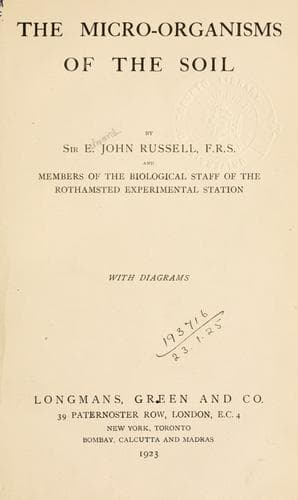
The micro-organisms of the soilRussell, Edward J. (Edward John)
Science
The micro-organisms of the soil
Russell, Edward J. (Edward John)
Soil microbiology
We know in a general way that earthworms effect the distribution of
the plant residues in the soil, and serve to disintegrate them; there
is no evidence, however, that they play any indispensable part in the
decomposition. Many root and other fragments do not go through this
process; observation shows that fungi can force a way in, and they may
be followed by nematodes which continue the disintegration. Possibly
some of the flagellates help, and certainly the bacteria do. After that
nothing is certain. We cannot, with certainty, assign any particular
reaction in the decomposition to any specific organism, with the
exception of the oxidation of the phenolic substances, the conversion
of ammonia to nitrite and nitrate, and the fixation of nitrogen. With
these exceptions many organisms seem capable of bringing about the
reactions, and indeed some of the reactions may be purely chemical and
independent of biological agencies.
The relationships between the soil population and soil fertility are
readily stated in general outline, but they are by no means clear cut
when one comes to details; fertility is a complex property, and some
of its factors are independent of soil micro-organisms.
The general relationship between plants and soil organisms is one of
complete mutual interdependence. The growing plant fixes the sun’s
energy and converts it into a form utilisable by the soil organisms;
without the plant they could not exist. The plant is equally dependent
on the soil organisms in at least two directions: their scavenging
action removes the dead vegetation which would, if accumulated on the
surface of the soil, effectively prevent most plants from growing.
Further, the plant is dependent on the soil population for supplies
of nitrates. Nothing is known about the relative efficiencies of the
various soil organisms as scavengers. Numerous fungi and bacteria are
effective producers of ammonia, the precursor of nitrates; it is not
known, however, whether flagellates and such higher forms as nematodes
act in this way.
Public-domain text, read in full here on John Shaqi.
Reviews
Reviews
No reviews yet
Be the first to share your thoughts on this work.
Elsewhere in the archive
Join the Discussion
Join the discussion
Sign in to leave a comment or review.
Sign InorCreate an account