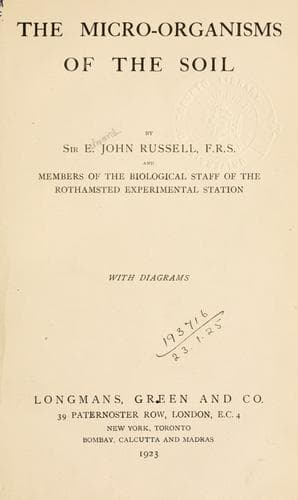
The micro-organisms of the soilRussell, Edward J. (Edward John)
Science
The micro-organisms of the soil
Russell, Edward J. (Edward John)
Soil microbiology
This widespread power of producing ammonia makes it impossible in our
present knowledge to regard any particular group of organisms as _par
excellence_ promoters of fertility. Indeed, it is safest not to attempt
to do so. The primary purpose of the activities of a soil organism
is to obtain energy and cell material for itself; any benefit to the
plant is purely incidental. For cell material it must have nitrogen
and phosphorus; here it competes with the plant. If it produces more
ammonia than it utilises--in other words, if it is driven to nitrogen
compounds for its energy, then the plant benefits. If, on the other
hand, it absorbs more ammonia than it produces, as happens when it
derives its energy from non-nitrogenous substances, the plant suffers.
Thus, addition of peptone to the soil or an increase in bacterial
numbers effected without addition of external energy (e.g. by partial
sterilisation) leads to increased ammonia supply, and, therefore,
to increased fertility. But addition of sugar to the soil causes so
great an increase of numbers of bacteria and other organisms that
considerable absorption of ammonia and nitrate occurs, and fertility
is for a time depressed.
Both actions proceed in soils partially sterilised by organic
substances, such as phenol, which are utilised by some of the soil
organisms; there is first a great rise in numbers of these particular
organisms with a depression of ammonia and nitrate, then a drop to the
new level, higher than the old one, and an increased production of
ammonia and nitrate resulting from the partial sterilisation effects.
We must then regard the soil population as concerned entirely to
maintain itself, and only incidently benefiting the plant, sometimes,
indeed, injuring it; always essential, yet always taking its toll, and
sometimes a heavy toll, of the plant nutrients it produces.
This effect makes it difficult to deduce simple quantitative
relationships between bacterial activity and soil fertility, and the
difficulty is increased by the fact that bacteria and plants may both
be injured or benefited by the same causes, so that high bacterial
numbers in a fertile soil would not necessarily be the cause, but might
be simply the result of fertility.
The circumstance that certain soil organisms--bacteria, algæ, and
fungi--themselves assimilate ammonia and nitrate may account for
the remarkable slowness of nitrate accumulation, to which reference
has already been made. The protein formed from the assimilated
nitrogen remains in the bodies of the organisms, living or dead, till
decomposition sets in. It is not difficult to picture a cycle of events
in which much of the nitrate formed is at once reabsorbed by other
organisms, and only little is actually thrown off into the soil. Such a
process might continue almost interminably so long as any carbonaceous
material remained.
Finally, we come to the very interesting problem--is it possible to
control the population of the soil?
Public-domain text, read in full here on John Shaqi.
Reviews
Reviews
No reviews yet
Be the first to share your thoughts on this work.
Elsewhere in the archive
Join the Discussion
Join the discussion
Sign in to leave a comment or review.
Sign InorCreate an account