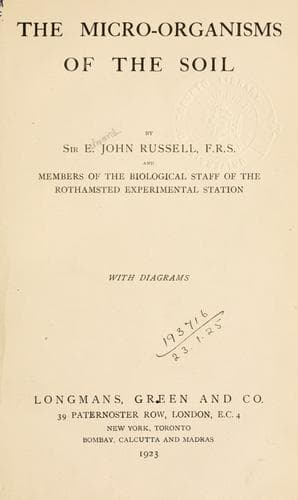
The micro-organisms of the soilRussell, Edward J. (Edward John)
Science
The micro-organisms of the soil
Russell, Edward J. (Edward John)
Soil microbiology
The problem may seem superfluous in view of the difficulties just
mentioned. Some aspects of it, however, are fairly clearly defined.
In the first instance, some organisms appear to be wholly harmful to
the plant; among them are parasitic eelworms and fungi, and bacteria
causing disease.
Control of these organisms can be brought about by partial
sterilisation, and of all methods heat is the most effective, but it
is costly, and attempts are now being made to replace it by chemical
treatment. The results are promising, but the investigation is
laborious; the organisms show specific relationships, and in finding
a sufficiently potent and convenient poison it is necessary in each
case to make an investigation into the relationship between chemical
constitution and toxicity to the particular organism concerned.
Formaldehyde is usually potent against fungi, and the cresols, and
particularly their chlor- and chloronitro-derivatives, are potent
against animals (eelworms, etc.).
One group of organisms is wholly beneficial, those associated with
leguminous plants. Attempts have been made to increase their activities
by inoculating the soil with more vigorous strains. The practical
difficulties still remain very considerable, but there is hope that
they may be overcome.
It is also possible to shift the balance of the soil population in
certain directions. Special groups of soil organisms can be caused
to multiply temporarily, if not permanently, by satisfying their
particular requirements. Thus, when a soil has been heated above 100°
C. it becomes specially suited to the growth of fungi, and quite
unsuited to certain bacteria such as the nitrifying organisms and
others; if this heated soil is infected with a normal soil population
the fungi develop to a remarkable extent. The nodule organisms appear
to be stimulated by addition of farmyard manure and of phosphates, and
the phenol-destroying organisms by successive small additions of phenol.
Finally, quite apart from the control of disease organisms, it is
possible to alter the soil population considerably by partial
sterilisation, using a temperature of only about 60° C., or a poison
like toluene that favours few of the soil organisms. This problem has
already been discussed in Chapter I.
The control of the soil population is still only in its infancy, but
it already promises useful developments. It cannot, however, be too
strongly insisted that the only sure basis of control is knowledge, and
we cannot hope to push control further till we have learned much more
about the soil population than we know at present.
AUTHOR INDEX.
ADAMETZ, 118.
Adams, 158.
Aiyer, 113.
Appel, 133.
Artari, 107.
Ashby, 42.
BARTHEL, 24.
Beijerinck, 6, 37, 41, 42, 46, 107.
Berthelot, 5, 6, 41.
Bewley, 47, 51, 132.
Bezssonoff, 69.
Boas, 138.
Bokorny, 138.
Bonazzi, 45.
Boresch, 107.
Boussingault, 3.
Bredemann, 24.
Bristol, 106.
Brizi, 113.
Public-domain text, read in full here on John Shaqi.
Reviews
Reviews
No reviews yet
Be the first to share your thoughts on this work.
Elsewhere in the archive
Join the Discussion
Join the discussion
Sign in to leave a comment or review.
Sign InorCreate an account