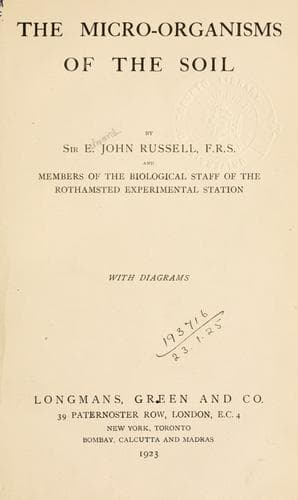
The micro-organisms of the soilRussell, Edward J. (Edward John)
Science
The micro-organisms of the soil
Russell, Edward J. (Edward John)
Soil microbiology
“Recherches sur l’assimilation de l’azote libre de l’atmosphère par
les microbes.” Arch. des Sci. Biolog. St. Petersburg, 1895, iii,
297-352.
For further details and fuller bibliography, see E. J. Russell, “Soil
Conditions and Plant Growth,” Longmans, Green & Co.
CHAPTER II.
SOIL BACTERIA.
_A._ OCCURRENCE AND METHODS OF STUDY.
To understand the development of our knowledge of soil bacteria, it
must be remembered that bacteriology is under the disadvantage that
it started as an applied science. Although bacteria were first seen
by Leeuwenhoeck about the middle of the seventeenth century, and
some of their forms described by microscopists of the eighteenth and
early nineteenth centuries, it was only with the work of Pasteur on
fermentation, and of Duvaine, Pasteur, and their contemporaries on
disease bacteria, that bacteriology may be said to have started.
From the outset, therefore, attention has been directed mainly to
the bacteria in their specialised relationship to disease or to
fermentation and similar processes. As a result, little research was
done on the pure biology of the bacteria, so that even now many of the
most fundamental and elementary problems concerning them are quite
unsolved.
In their work on fermentations and disease bacteria, the earlier
workers were assisted by the fact that under both sets of conditions
the causative bacteria exist, as a rule, either in practically pure
culture, or else in preponderating numbers. The study and elucidation
of such a mixed micro-population as exists in the soil, became possible
only when methods had been devised for isolating the different kinds
of bacteria, and thus studying them apart from each other. It was the
development of the gelatine plate method of isolating pure cultures by
Koch[36] in 1881 that made the study of the soil bacteria practicable.
The plating method opened up two lines of research. In the first
place, it provided a simple means of isolating organisms from the mixed
population of the soil, and thus enabled a qualitative study to be made
of each organism in pure culture, and, in the second place, from it was
developed a counting technique for estimating differences in bacterial
numbers between samples of soil, from which has sprung much of our
knowledge of the quantitative side.
Public-domain text, read in full here on John Shaqi.
Reviews
Reviews
No reviews yet
Be the first to share your thoughts on this work.
Join the Discussion
Join the discussion
Sign in to leave a comment or review.
Sign InorCreate an account