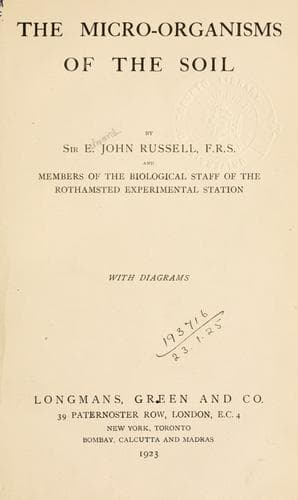
The micro-organisms of the soilRussell, Edward J. (Edward John)
Science
The micro-organisms of the soil
Russell, Edward J. (Edward John)
Soil microbiology
Although a large number of the common organisms in the soil produce
ammonia in culture media containing peptone, the relative importance
of these in the soil has yet to be decided. It was supposed that the
spore-forming organisms related to _Bacillus mycoides_ were of chief
importance. This supposition dates from the work of Marchal,[49] who
studied the production of ammonia by an organism of this group in
culture solution, and found it to be a very active ammonifier. As
already mentioned, however, there is some doubt as to whether the large
spore-forming organisms are very active under soil conditions.[12],[13]
The existence of rapid fluctuations in nitrate content, found to exist
in soil, may in the future indicate which are the most active of the
common bacteria in the soil itself by enabling us to observe which
types increase during periods of rapid ammonia and nitrate formation.
(3) _Nitrate Production._
The ammonia produced in the soil under normal field conditions is
rapidly oxidised successively to nitrite and to nitrate, a process
known as nitrification. The process of nitrification is more rapid than
that of ammonia production, with the consequence that no more than
traces of ammonia are able to accumulate. The rate at which nitrate is
formed in the soil is consequently set by the slower process of ammonia
production.
The work of Schloesing and of Warington showed that the oxidation
of ammonia was the work of living organisms. It is, however, to
Winogradsky’s isolation and study of the causative organisms that we
owe our present knowledge of the biology of the process. By a new
and ingenious technique, he isolated from soil two remarkable groups
of bacteria that bring about nitrification. The first group oxidises
ammonium carbonate to nitrite, and was divided by Winogradsky into
the two genera, _Nitrosomonas_, a very short rod-like organism bearing
a single flagellum, and _Nitrosococcus_, a non-motile form found in
South America. The second group oxidises nitrites to nitrates. They are
minute pear-shaped rods to which he gave the name _Nitrobacter_.
Winogradsky found that the first, or nitrite-producing group, would
live in a culture solution containing:--
2·25 grams ammonium sulphate,
2·0 „ sodium chloride,
1·0 „ magnesium carbonate,
to the litre of well water.
Public-domain text, read in full here on John Shaqi.
Reviews
Reviews
No reviews yet
Be the first to share your thoughts on this work.
Join the Discussion
Join the discussion
Sign in to leave a comment or review.
Sign InorCreate an account