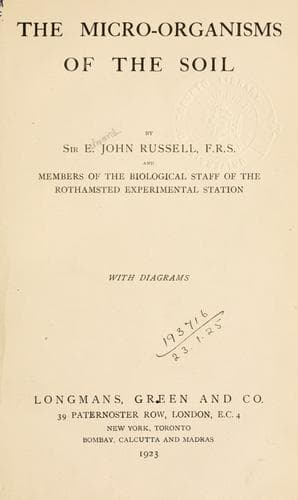
The micro-organisms of the soilRussell, Edward J. (Edward John)
Science
The micro-organisms of the soil
Russell, Edward J. (Edward John)
Soil microbiology
Were it not for the recent advances that have been made in our
knowledge of the mode of nutrition of many of the lower algæ, it would
be very difficult to account for the widespread occurrence of algæ in
the soil, for it is undoubtedly true of some of the more highly evolved
algæ that their mode of nutrition is entirely typical of that of green
plants in general. The application of bacteriological technique to the
algæ, however, by Beijerinck, by Artari, and by Chodat and his pupils,
and the introduction of pure-culture methods have led to a study of
the physiology of some of the lower algæ, in the hope of getting to
understand some of the fundamental problems underlying the nutrition
of organisms containing chlorophyll. It is impossible here to do more
than mention the names of a few of the more important of those who
have worked along these lines, such as Chodat, Artari, Grintzesco,
Pringsheim, Kufferath, Nakano, Boresch, Magnus and Schindler, and to
condense into a few sentences some of their more important conclusions.
It is now established that although in the light the algæ are able to
build up their substance from CO₂ and water containing dilute mineral
salts, yet in such conditions growth is sometimes very slow, and with
some species at any rate it is greatly accelerated by the addition of
a small quantity of certain organic compounds. The ability of the lower
algæ to use organic food materials varies specifically, quite closely
related forms often reacting very differently to the same substance,
but there have been shown to be a considerable number of forms which
can make use of organic compounds to such an extent that they can
grow entirely independently of light. In such cases the nutrition
of the organism becomes wholly saprophytic, and the chlorophyll may
be completely lost; it has frequently been observed, however, that
on suitable nutrient media, even in complete darkness, certain algæ
continue to grow and retain their green colour, provided that a
sufficient supply of a suitable nitrogenous compound is present.
_Chlorella vulgaris_, an alga frequently found in soil, has been shown
to be extremely plastic in its relations to food substances. Given only
a dilute mineral-salts solution as food source, it absorbs CO₂ from
the air, and grows in sunlight with moderate rapidity. The addition
of glucose to the medium in the light greatly increases the rate and
amount of growth and the size of the cells, while in the dark the
colonies not only remain green but have been shown to develop more
vigorously than in full daylight. The organism is also able to use
peptone as a source of nitrogen in place of nitrates.
Public-domain text, read in full here on John Shaqi.
Reviews
Reviews
No reviews yet
Be the first to share your thoughts on this work.
Elsewhere in the archive
Join the Discussion
Join the discussion
Sign in to leave a comment or review.
Sign InorCreate an account