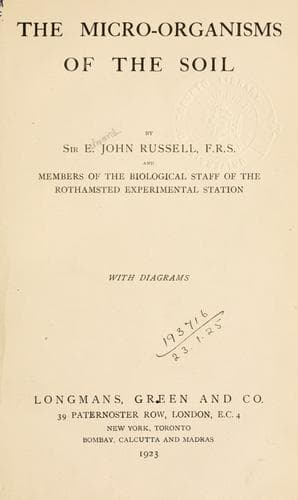
The micro-organisms of the soilRussell, Edward J. (Edward John)
Science
The micro-organisms of the soil
Russell, Edward J. (Edward John)
Soil microbiology
_Stichococcus bacillaris_ and _Scenedesmus spp._, also occurring
in soils, have been shown to be almost equally adaptable, though
in these cases the organisms grow more slowly in the dark than on
the corresponding medium in the light. Liquefaction of gelatine by
the secretion of proteolytic enzymes has been shown to be a further
property of certain species, resulting in the formation of amino acids
such as glycocoll, phenylalanine, dipeptides, etc. This property is,
however, possessed by only a limited number of species and in varying
degree.
Up to the present very little work of this kind has been done upon algæ
actually taken from the soil, and our knowledge is therefore very
scanty. Of the species so far examined all show considerable increase
in growth on the addition to the medium of glucose and other sugars,
and tend to be partially saprophytic; a few have been shown to liquefy
gelatine to some extent.
Servettaz, Von Ubisch, and Robbins have also demonstrated that the
protonema of some mosses can make use of certain organic substances,
especially the sugars, and grow vigorously in the dark. It has been
shown, however, that light is essential for the development of the moss
plant.
It was thought at Rothamsted that some light might be thrown upon the
activities of the soil-algæ by making counts of the numbers present
in samples of soil taken periodically within a circumscribed area.
A dilution method similar to that in use in the protozoological
laboratory was adopted and applied to samples of arable soil taken
from the surface, and at depths of 2, 4, 6 and 12 inches vertically
beneath. A considerable number of samples were examined in this way
from two plots on Broadbalk wheat-field, viz.: the unmanured plot and
that receiving a heavy annual dressing of farmyard manure. The numbers
in the unmanured soil were observed to fall far short of those in that
containing a large amount of organic matter, while in both plots the
numbers varied considerably at different times of the year. The chief
species in both plots were identical, and their vertical distribution
was fairly uniform, but it was observed that the numbers of individuals
varied according to the depth of the sample. The 6th and 12th inch
samples contained very few individuals of comparatively few species,
but the 4th inch samples yielded numbers that were not significantly
less than those in the top inch. The 2nd inch sample was usually much
poorer in individuals than either the top or the 4th inch.
Public-domain text, read in full here on John Shaqi.
Reviews
Reviews
No reviews yet
Be the first to share your thoughts on this work.
Elsewhere in the archive
Join the Discussion
Join the discussion
Sign in to leave a comment or review.
Sign InorCreate an account