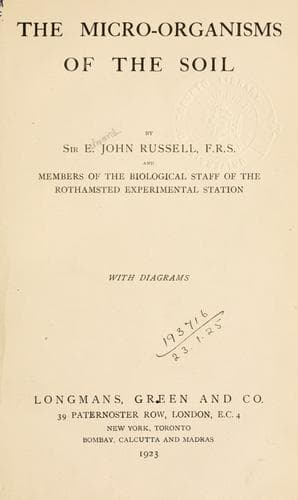
The micro-organisms of the soilRussell, Edward J. (Edward John)
Science
The micro-organisms of the soil
Russell, Edward J. (Edward John)
Soil microbiology
It is unfortunate that this method of counting is not really
satisfactory for the algæ, chiefly because it takes no account of the
blue-green forms. The gelatinous envelope which encloses the filaments
of these algæ prevents their breaking up into measurable units.
Assuming, as appears to be the case for the two plots investigated,
that the blue-green algæ are at least as numerous as the green forms,
the total numbers should probably be at least twice as great as those
calculated. Taking 100,000 as a rough estimate of the number of algæ
per gram of manured soil in a given sample, and assuming the cells to
be spherical and of average diameter 10µ, it has been calculated that
the volume of algal protoplasm present was at least 3 times that of
the bacteria though only one-third of that of the protozoa. This is
probably only a minimum figure for this sample.
A soil population of this magnitude can not be without effect on the
fertility of the soil. When growing on the surface of the ground
exposed to sunlight the algæ must, by photosynthesis, add considerably
to the organic matter of the soil, but when they live within the soil
itself their nutrition must be wholly saprophytic, and they can be
adding nothing either to the energy or to the food-content of the soil.
How these organisms fit into the general scheme of life in the soil is
at present undetermined, and there is a wide field for research in this
direction.
III. RELATION OF ALGÆ TO THE NITROGEN CYCLE
Probably the most important limiting factor in British agriculture is
the supply of nitrogen available for the growing crop, and it seems
likely that the soil-algæ are intimately connected with this question
in several ways.
Periodic efforts have been made during the last half century to
establish the fact that a number of the lower organisms, including
the green algæ, have the power of fixing atmospheric nitrogen and
converting it into compounds which are then available for higher
plants. This property has been definitely established for certain
bacteria, and rather doubtfully for some of the fungi, but until
recently no authentic proof had been produced that algæ by themselves
could fix nitrogen. The subject is too wide to be discussed in much
detail here.
Schramm in America, working with pure cultures of algæ, tried for
ten years to establish the fact of nitrogen fixation, and failed
completely; more recently Wann has extended Schramm’s work, and claims
to have proved indisputably that, given media containing nitrates as
a source of nitrogen and a small amount of glucose, the seven species
of algæ tested by him fixed atmospheric nitrogen to the extent of 4-54
per cent. of the original nitrogen content of the medium. So important
a result needed corroboration, and Wann’s experiment, with some slight
improvements, was therefore repeated at Rothamsted last summer.
Public-domain text, read in full here on John Shaqi.
Reviews
Reviews
No reviews yet
Be the first to share your thoughts on this work.
Elsewhere in the archive
Join the Discussion
Join the discussion
Sign in to leave a comment or review.
Sign InorCreate an account