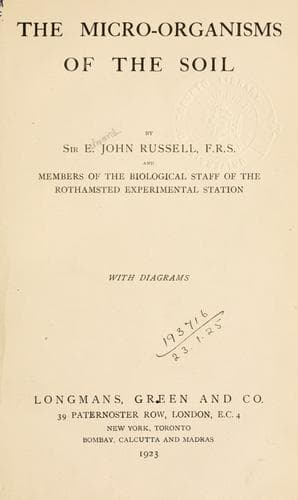
The micro-organisms of the soilRussell, Edward J. (Edward John)
Science
The micro-organisms of the soil
Russell, Edward J. (Edward John)
Soil microbiology
In warmer countries than our own, especially those with an adequate
rainfall, the significance of soil algæ is perhaps more obvious to
a casual observer. Treub states that after the complete destruction
of the island of Krakatoa by volcanic eruption in 1883, the first
colonists to take possession of the island were six species of
blue-green algæ, viz., _Tolypothrix_ sp., _Anabæna_ sp., _Symploca_
sp., _Lyngbya_ 3 spp. Three years after the eruption these organisms
were observed to form an almost continuous gelatinous and hygroscopic
layer over the surface of the cinders and stones constituting the soil,
and by their death and decay they rapidly prepared it for the growth
of seeds brought to the island by visiting birds. Hence the new flora
which soon established itself upon the island can be said to have
had its origin in the alga-flora which preceded it. Fritsch has also
emphasised the importance of algæ in the colonisation of new ground in
Ceylon.
Welwitsch ascribes the characteristic colour from which the “pedras
negras” in Angola derive their name to the growth of a thick stratum of
_Scytonema myochrous_, a blue-green alga, which gradually becomes black
and completely covers the soil. At the close of the rainy season this
gelatinous stratum dries up very slowly, enabling the underlying soil
to retain its moisture for a longer period than would otherwise be the
case.
The gelatinous soil algæ are probably very important in this respect,
for their slow rate of loss of water is coupled with a capacity for
rapid absorption, and they are therefore able to take full advantage of
the dew that may be deposited upon them and increase the power of the
soil to retain moisture.
V. RELATION OF ALGÆ TO GASEOUS INTERCHANGES IN THE SOIL.
Public-domain text, read in full here on John Shaqi.
Reviews
Reviews
No reviews yet
Be the first to share your thoughts on this work.
Elsewhere in the archive
Join the Discussion
Join the discussion
Sign in to leave a comment or review.
Sign InorCreate an account