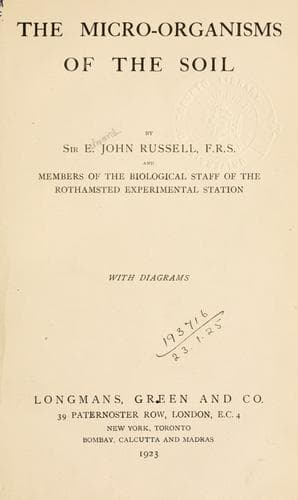
The micro-organisms of the soilRussell, Edward J. (Edward John)
Science
The micro-organisms of the soil
Russell, Edward J. (Edward John)
Soil microbiology
In the cultivation of rice the algæ of the paddy field have been found
to be of extreme importance. Brizi in Italy has shown that although
rice is grown under swamp conditions yet the roots of the rice plant
are typical of those of ordinary terrestrial plants and have none
of the structural adaptations to aquatic life so characteristic of
ordinary marsh plants. Hence the plants are entirely dependent for
healthy growth upon an adequate supply of oxygen to their roots from
the medium in which they are growing. A serious disease of the rice
plant, characterised by the browning and dying off of the leaves,
which was thought at first to be due to the attacks of fungi, was
found to be the effect of the inadequate aeration of the roots, while
the entry of the fungi was shown to be subsequent to the appearance
of the physiological disease. The presence of algæ in the swamp water
was found to prevent the appearance of this disease, in that they
unite with other organisms to form a more or less continuous stratum
over the surface of the ground, and add to the gases which accumulate
there large quantities of oxygen evolved during photosynthesis. The
concentration of dissolved oxygen in the water percolating through the
soil is thereby raised to a maximum, and the healthy growth of the crop
ensured.
This work has been corroborated by Harrison and Aiyer in India, and a
sufficient supply of algæ in the swamp water is now regarded as one of
the essentials for the production of a good rice crop.
From what has been said, it appears that, although our knowledge of
the soil algæ is extremely limited, and our conception of the part
they play is largely based on speculation, yet the subject is one of
enormous interest and worthy of investigation in many directions. In
its present undeveloped state, it is a little difficult to foresee
which lines of study are likely to prove most profitable, but there
is little doubt that eventually the soil algæ will be shown to play a
significant part in the economy of the soil.
SELECTED BIBLIOGRAPHY.
* _Papers giving extensive bibliographies._
I. GENERAL.
[1] Bristol, B. M., “On the Retention of Vitality by Algæ from Old
Stored Soils,” New Phyt., 1919, xviii., Nos. 3 and 4.
[2] Bristol, B. M., “On the Alga-Flora of some Desiccated English
Soils: an Important Factor in Soil Biology,” Annals of Botany, 1920,
vol. xxxiv., No. 133.
[3] Brizi, U., “Ricerche sulla Malattia del Riso detta ‘Brusone,’
Sect. IV. Influenza che le alghe verdi esercitano in risaia,”
Annuario dell Instituzione Agraria Dott. A. Ponti, Milan, 1905, vol.
vi., pp. 84-89.
[4] Esmarch, F., “Beitrag zur Cyanophyceen-Flora unserer Kolonien,”
Jahrb. der Hamburgischen wissensch. Anstalten, 1910, xxviii., 3.
Beiheft, S. 62-82.
[5] Esmarch, F., “Untersuchungen über die Verbreitung der
Cyanophyceen auf und in verschiedenen Boden,” Hedwigia, 1914, Band
lv., Heft 4-5.
Public-domain text, read in full here on John Shaqi.
Reviews
Reviews
No reviews yet
Be the first to share your thoughts on this work.
Elsewhere in the archive
Join the Discussion
Join the discussion
Sign in to leave a comment or review.
Sign InorCreate an account