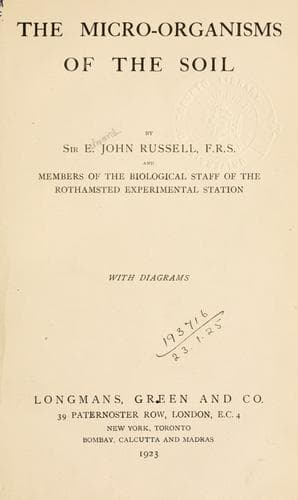
The micro-organisms of the soilRussell, Edward J. (Edward John)
Science
The micro-organisms of the soil
Russell, Edward J. (Edward John)
Soil microbiology
No comparative estimations have been made of the number of fungi in
the soils of different regions. There are, however, certain figures
which show that decided seasonal differences exist. Thus, correcting
and averaging certain of Waksman’s results[25] the following numbers
of fungi per gram of soil at 4 inches deep are obtained; September,
768,000; October, 522,000; November, 310,000; January, 182,000. At
Rothamsted results have been obtained which would appear to mark
a clear seasonal rhythm, corresponding in the time of its maxima
in Autumn and Spring with the periodicities known for many other
ecological communities (Fig. 19).
The numbers of fungi at various depths in the soil show very clearly
marked differences. The distribution in the top 4-6 inches depending
probably upon the depth of soil, is more or less equal, but there is a
very rapid falling off in numbers, especially between 5-9 inches, until
at 20-30 inches fungi are either very few in number or absent. Thus
Takahashi[22] found 590,000 fungi per gram at a depth of 2 cms. and
only 160,000 at 8 cms.
TABLE XIII.--INFLUENCE OF SOIL TREATMENT UPON THE NUMBERS OF FUNGI AS
DETERMINED BY THE PLATE METHOD--(AFTER WAKSMAN).
+--------------------------+---------+-----------------+
| | |Numbers of Fungi |
| Soil Fertilisation. |Reaction.|per Gram of Soil.|
+--------------------------+---------+-----------------+
| | P.H. | |
|Minerals only | 5·6 | 37,300 |
|Heavily manured | 5·8 | 73,000 |
|Sodium nitrate | 5·8 | 46,000 |
|Ammonium sulphate | 4·0 | 110,000 |
|Minerals and lime | 6·6 | 26,200 |
|Ammonium sulphate and lime| 6·2 | 39,100 |
+--------------------------+---------+-----------------+
The type of soil and its treatment exercise a great influence over
the number of fungi present. Fischer[6] found that farmyard manure
increased the number of fungi in uncultivated “Hochmoor,” cultivated
“Grunlandmoor,” and a clay soil by two, three, and five times
respectively. Waksman’s results[25] indicate that the more fertile
soils contain more fungi, both in number and species, than the less
fertile ones, and if one averages his results, the following figures
are obtained: garden soil, 525,000 per gram; orchard soil, 250,000;
meadow soil, 750,000; and forest soil, 151,000. Recently Waksman[25_e_]
has found that manure and acid fertilisers increase the numbers of
fungi in the soil, whereas the addition of lime decreases them (Table
XIII.).
Jones and Murdock[10] examined surface and sub-surface samples of
forty-six soils representing seventeen soil types in eastern Ontario.
Molds were fairly uniform in numbers in all soils except a sandy clay
loam and sandy clay shale, in which they were absent.
Public-domain text, read in full here on John Shaqi.
Reviews
Reviews
No reviews yet
Be the first to share your thoughts on this work.
Elsewhere in the archive
Join the Discussion
Join the discussion
Sign in to leave a comment or review.
Sign InorCreate an account