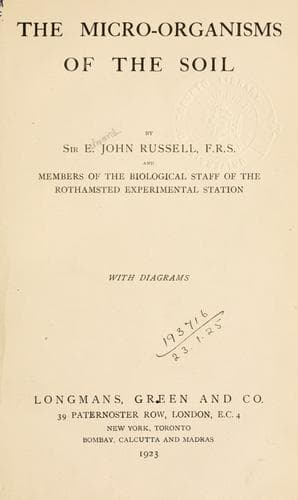
The micro-organisms of the soilRussell, Edward J. (Edward John)
Science
The micro-organisms of the soil
Russell, Edward J. (Edward John)
Soil microbiology
Older classifications of fungi frequently divided these organisms
into four categories--parasites, saprophytes, facultative parasites,
and facultative saprophytes, but the further mycological studies are
carried the more clearly it is seen that these groups are entirely
artificial. There are probably few fungi that cannot, under particular
conditions, invade living tissues, and it only seems a question of
time before at all events the vast majority of fungi will be grown on
synthetic media in the laboratory. From our present point of view the
importance of this lies in the fact that fungi living saprophytically
in the soil may, given the right conditions or the presence of some
particular host plant, become parasites or symbionts, and conversely
well-known pathogens may live a saprophytic existence. Thus Cucumber
Leaf Spot is caused by _Colletotrichum oligochætum_, and Bewley[3] has
repeatedly isolated this fungus from glasshouse manure and refuse of
various kinds. In his early studies, Butler[13] isolated many parasitic
species of _Pythium_ from Indian soils, and the presence of _P. de
Baryanum_ as a soil saprophyte has been confirmed by Bussey, Peters,
and Ulrich.[11] De Bruyn[17] has recently found that most species of
_Phytophthora_, including _P. erythroseptica_ and _P. infestans_ may
live as saprophytes in the soil, whilst Pratt[53] has isolated from
virgin lands and desert soils various fungi, which cause disease in
potatoes. In 1912 Jensen[29] gave a list of twenty-three “facultative
parasites” isolated from soil, and these are but a moiety of those
which could be listed to-day.
Public-domain text, read in full here on John Shaqi.
Reviews
Reviews
No reviews yet
Be the first to share your thoughts on this work.
Elsewhere in the archive
Join the Discussion
Join the discussion
Sign in to leave a comment or review.
Sign InorCreate an account