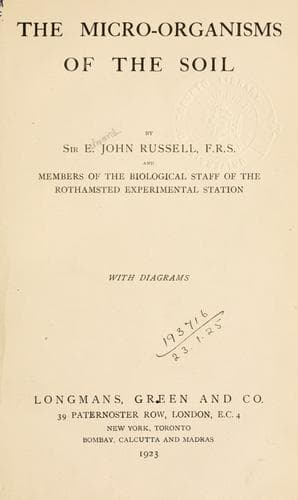
The micro-organisms of the soilRussell, Edward J. (Edward John)
Science
The micro-organisms of the soil
Russell, Edward J. (Edward John)
Soil microbiology
Furthermore, it was shown by Frank[24] many decades ago that forest
humus is not merely a mass of the remains of animals and plants,
but that a considerable part of its organic substance is made up of
fungus hyphæ, which ramify and penetrate in all directions. Evidence
is rapidly accumulating that this is also true of most other soils
containing organic matter. It is well known that many of the higher
plants live in symbiotic or commensal relationship with these humus
fungi, which are present in the host tissues as mycorrhiza, and further
studies only serve to show the widespread and fundamental nature
of this relationship. Thus many _Basidiomycetes_[50] (species of
_Tricholoma_, _Russula_, _Cortinarius_, _Boletus_, _Elaphomyces_, etc.)
possess a mycorrhizal relationship with various broad leaved trees,
such as beech, hazel, and birch[57] and with various conifers and
certain Ericales. Other Ericales show this relationship with species of
the genus _Phoma_,[62] many orchids, with species of _Rhizoctonia_[2]
(or _Orcheomyces_[10]), whilst _Gastrodia elata_ contains _Armillaria
mellea_.[36] Certain species of _Pteridophyta_ and _Bryophyta_ are
also known to certain mycorrhizal fungi. Of the numerous fungi taking
part in these mycorrhizal relationships, only a small number have yet
been identified, but there is little doubt that perhaps the majority
of these organisms must be regarded as true soil forms.[14],[45] The
mycological flora of the soil thus plays an important part in the life
of many higher forms of vegetation, and this relationship is a very
fruitful field for study.
RELATION OF FUNGI TO SOIL PROCESSES.
The great cycle of changes occurring in the soil whereby organic matter
is gradually transformed and again made available as plant food is
entirely dependent upon micro-organisms. Until a decade ago it was
thought that bacteria were by far the most important group concerned
in the bringing about of these changes, but recent studies have shown
that, in at all events certain arcs of this great organic cycle,
the fungi have, perhaps, an equal part to play. The life of fungi
in the soil may, for our purposes, be considered from three points
of view--their part in the decomposition of carbon compounds, their
nitrogen relationships, and their work in the mineral transformations
of the soil.
CARBON RELATIONSHIPS.
Public-domain text, read in full here on John Shaqi.
Reviews
Reviews
No reviews yet
Be the first to share your thoughts on this work.
Elsewhere in the archive
Join the Discussion
Join the discussion
Sign in to leave a comment or review.
Sign InorCreate an account