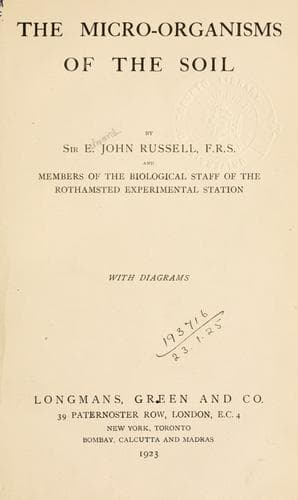
The micro-organisms of the soilRussell, Edward J. (Edward John)
Science
The micro-organisms of the soil
Russell, Edward J. (Edward John)
Soil microbiology
Of primary importance in the carbon relationships of soil fungi is
the part played in the decomposition of the celluloses, which compose
almost all the structural remains of plant tissues. Our first real
knowledge of this subject was given by Van Iterson[28] in 1904 when he
showed the wide extent of cellulose destruction by fungi, and devised
methods whereby fifteen cellulose-decomposing forms, many of which have
since proved to be common soil fungi, were isolated. Three years later
Appel[1] published his account of the genus _Fusarium_, and showed
that many of the species could destroy filter paper. A difficulty was
introduced in 1908 by Schellenberg,[60] who, working with common soil
forms, found that only hemicelluloses and not pure cellulose were
destroyed. This has recently been supported by Otto,[48] but from the
practical point of view the discussion is academic for the amount of
pure cellulose in plants is insignificant.
In 1913 McBeth and Scales[43] showed that a considerable number
of common soil fungi were most active cellulose destroyers, pure
precipitated cellulose and cotton being readily attacked. This was
supported by McBeth in 1916,[42] whilst Scales[59] has found that
most species of _Penicillium_ and _Aspergillus_ decompose cellulose,
especially where ammonium sulphate is the source of nitrogen.
Waksman[65] tested twenty-two soil fungi and found that eleven
decomposed cellulose rapidly and four slowly, whilst Dascewska,[16]
Waksman,[66],[67] and others have concluded that soil fungi play
a more important part in the decomposition of cellulose and in
“humification” than soil bacteria. Schmitz[61] has recently shown that
cellulose-destroying bacteria play no important part in the decay of
wood under natural conditions.
In addition to the celluloses, practically all simple and complex
organic carbon compounds are attacked by soil fungi, and in many cases
the decomposition is very rapid.[26] Many _Actinomycetes_, _Aspergilli_
and _Penicillia_ are active starch splitters, and it is of interest to
note that some of the strongest cellulose decomposers (_Melanconium
sp._, _Trichoderma sp._, and _Fusaria_) secrete little diastase.[66]
The _Mucorales_ apparently do not attack cellulose, but can only
utilise pectin bodies, monosaccharides, and partly disaccharides.[26]
Dox and Neidig[19] have shown that various species of _Aspergillus_
and _Penicillium_ are able to attack the soil pentosans. Roussy,[58]
Kohshi,[24] Verkade and Söhngen,[64] and many other workers have found
that fats and fatty acids are readily used as food by soil fungi, and
Koch and Oelsner[33] have recently shown that tannins are readily
assimilated. Klöcker,[32] Ritter,[56] and others have shown that the
utilisation of many carbon compounds is to a large extent determined by
the source of nitrogen and its concentration in the pabulum.
Public-domain text, read in full here on John Shaqi.
Reviews
Reviews
No reviews yet
Be the first to share your thoughts on this work.
Elsewhere in the archive
Join the Discussion
Join the discussion
Sign in to leave a comment or review.
Sign InorCreate an account