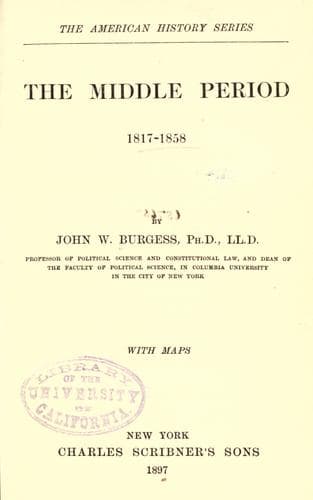
United States -- History -- 1815-1861; United States -- Politics and government -- 1815-1861
First Appearance of Slavery in the British North American
Colonies--Early Theory of the Benefits of Slavery--The Earliest Legal
Recognition of Slavery in the Colonies--Northern Colonies not well
Adapted to Negro Labor--The Southern Colonies well Adapted to Negro
Labor--Negro Slavery a Temporary Necessity in the South--Was Negro
Slavery an Error and an Evil from the first?--Slavery Legislation in
the Southern Colonies--Partus Sequitur Ventrem--Definitions of the
Slave Class--The Test of the Slave Status as Fixed by the Virginia
Statute--The Legal Position of the Slave--Tendency Toward Serfage in
the Code of 1705--Public Relations of the Slave System--The General
Object of the Laws in respect to Slaves--Slavery and the Revolutionary
Ideas of the Rights of Man--First Prohibition upon Slave
Importation--Abolition of Slavery in the Northern Commonwealths after
the Beginning of the Revolution--Slavery and the Constitution of
1787--Reaction against the Humanitarian Principles of the
Revolution--Abolition of the Foreign Slave-trade by Congress--Cotton
Culture and the Cotton-gin--The Effect of the Return to the Arts of
Peace upon the Ideas Concerning Slavery--Slavery During the War of
1812 and the Years just before and just after this War--Slavery in the
Louisiana Territory--Slavery in the territory West of North Carolina
and Georgia--Slavery in Louisiana a Different Question from Slavery in
the North Carolina and Georgia Cessions--Interest in Slavery in
Maryland and Virginia Increased by the Acquisition of Louisiana--The
Domestic Slave-trade--The Relation of Slavery to the Diplomacy of the
United States.
It is not easy to define the term slavery in the abstract without
unfitting it for application to the great majority {40} of the systems
of servitude which have ever existed. Especially will it be difficult
to gain a correct conception of the relation between the white man and
the negro in North America previous to 1860 by means of such a
definition.
The institution of negro slavery in the United States was an
historical growth, which was in some respects unique. We shall,
therefore, do better to follow the main stages of that development
than to attempt at the outset any definition whatsoever. We may, in
this manner, build up a true description of it, and escape the error
frequently contained in the brevity of a definition and in the nature
of an abstract proposition.
[Sidenote: First appearance of slavery in the British North American
colonies.]
[Sidenote: Early theory of the benefits of slavery.]
Public-domain text, read in full here on John Shaqi.
Reviews
Reviews
No reviews yet
Be the first to share your thoughts on this work.
Join the Discussion
Join the discussion
Sign in to leave a comment or review.
Sign InorCreate an account