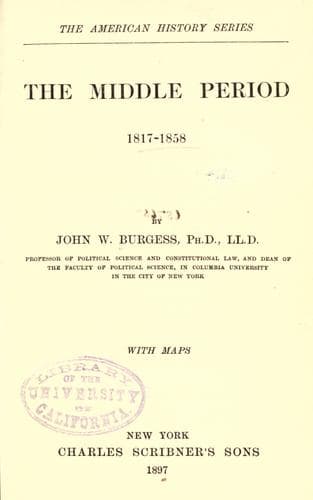
United States -- History -- 1815-1861; United States -- Politics and government -- 1815-1861
These last acts seem to have aroused the consciousness of the Congress
to the rapidity with which the whole country was becoming again
subject to the slave-holding interests. The Congress resisted the
importunities of the Indiana leaders, and after giving South Carolina
a reasonable time to re-enact her law abolishing the foreign
slave-trade, without effect, proceeded itself to abolish the trade
from the first moment that the Constitution permitted this to be done,
from January 1st, 1808.
[Sidenote: Cotton culture and the cotton-gin.]
[Sidenote: The effect of the return to the arts of peace upon the
ideas concerning slavery.]
It has been customary to ascribe the great revulsion {52} of view in
regard to slavery, which certainly manifested itself everywhere in the
United States between 1790 and 1807, to cotton culture and the
cotton-gin. The invention of the cotton-gin, in the first part of the
last decade of the eighteenth century, and the increased demand for
cotton fabrics throughout the world, had made the cultivation of
cotton highly profitable. An increase in cotton culture was naturally
encouraged by such enhanced profits, and this tendency produced an
increased demand for negro labor and for new lands, since the cotton
crop requires a warm climate and low lands, and exhausts the soil very
rapidly. Those parts of the country adapted to cotton-raising felt,
therefore, a renewed interest in the increase of negro labor and in
territorial extension. And those parts not so adapted felt an indirect
interest in the same, since the increased and still increasing profits
of the cotton culture made a market for their slaves and a carrying
trade for their shipowners. There is no doubt that such was the main
cause of the great change of view in regard to the question of negro
slavery which the country experienced between 1790 and 1810, but it
was not the sole cause. It was inevitable that, when the men of that
era passed out of the excited state of mind and feeling produced by
the War with the motherland, and came to the task of re-establishing
the relations of peace and every-day life and business, they should
regain a calmness of judgment, a respect for vested rights, and a
regard for customary relations, which placed the political philosophy
of 1776 under many limitations and qualifications, some of which,
certainly, were sound and valuable. It is only when we take all of
these considerations together that we comprehend the reasoning of the
men of the first decade of this {53} century upon the great question.
They saw a great interest developing which was bringing wealth and
comfort into an impoverished country. They knew that it could be then
sustained only by negro labor. They did not believe that the negro
would work unless forced to it by the white man. They thought it was
better for the negro himself to have food, clothing, and shelter, in
slavery, than to starve, or become a robber, in liberty. They felt, on
Public-domain text, read in full here on John Shaqi.
Reviews
Reviews
No reviews yet
Be the first to share your thoughts on this work.
Join the Discussion
Join the discussion
Sign in to leave a comment or review.
Sign InorCreate an account