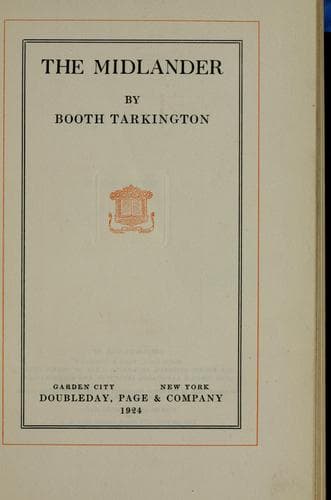
Middle West -- Fiction; Real estate developers -- Fiction; Suburbs -- Fiction
In such a picture, block after block of heavy old mansions would be seen
to topple; row on row of stout buildings would vanish almost
simultaneously; families would be shown in flight, carrying away their
goods with them from houses about to crumble; miles of tall trees would
be uprooted; the earth would gape, opening in great holes and long
chasms;—the very streets would unskin themselves and twist in agony;
every landmark would fly dispersed in powder upon the wind, and all
old-established things disappear.
Such a picture would be but the truth with time condensed;—that is to
say, the truth made like a man’s recollection of events—and yet it
would not be like the truth as the truth appeared to Daniel Oliphant and
the other men who made the growth, nor like their subsequent memories.
For these men saw, not the destruction, but only the city they were
building; and they shouted their worship of that vision and were
exultant in the uproar. They shouted as each new skyscraper rose
swimming through the vast drifts of smoke, and shouted again as the
plain, clean, old business streets collapsed and the magnificent and
dirty new ones climbed above the ruins. They shouted when business went
sweeping outward from its centre, tearing away the houses where people
had lived contentedly for so long; and they shouted again as the new
factory suburbs marched upon the countryside, far and wide, and the
colossal black plumes of new chimneys went undulating off into a
perpetual smoke-mist, so that the distant level plain seemed to be a
plain surrounding not a city, but an ever-fuming volcano.
Once again, in the interminably cycling repetition of the new displacing
the old, then becoming the old and being displaced in turn, an old order
was perishing. The “New Materialism” that had begun to grow with the
renewed growing of the country after the Civil War, and staggered under
the Panic of ’73, but recovered and went on growing egregiously, had
become an old materialism now. It had done great things and little
things. Amongst the latter, it had furnished Europe with a caricature
type of the American—the “successful American business man.” On the
shelf, beside the figure of the loud-tweeded Boxing Briton with his
“side whiskers,” Europe set the lank-and-drawling, chin-bearded,
palace-buying Boaster of the Almighty Dollar, the Yankee of the great
boom period.
Public-domain text, read in full here on John Shaqi.
Reviews
Reviews
No reviews yet
Be the first to share your thoughts on this work.
Elsewhere in the archive
Join the Discussion
Join the discussion
Sign in to leave a comment or review.
Sign InorCreate an account