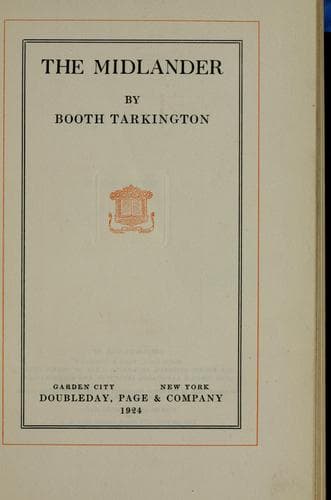
Middle West -- Fiction; Real estate developers -- Fiction; Suburbs -- Fiction
THE Oliphants’ high white iron fence was a hundred and fifty feet long
on National Avenue, a proud frontage, but the next yard to the north had
one even prouder: it was of a hundred and eighty feet, and the big house
that stood in this yard was almost that far back from the street. Built
of brick and painted white, it reached a palatial climax in a facing of
smooth white stone under a mansard roof, and the polished black walnut
front doors opened upon a stone veranda. From the veranda a broad stone
path led through the lawn and passed a stone fountain on its way to the
elaborate cast-iron front gate, which was a congenial neighbour to the
Oliphants’ cast-iron gate to the south. The stone fountain culminated in
a bronze swan, usually well supplied with ejectory water in the
summertime but somewhat bleak of aspect in winter, when the swan’s open
beak, perpetually vacant, suggested to an observer the painful strain of
unending effort absolutely wasted. It was a relief, after a snowstorm,
to see the too-conscientious cavity partially choked.
A little snow remained there, like a cupful of salt that the dutiful
bird had firmly refused to swallow, and snow glistened also along its
dark green back, one February afternoon, when a lady on her way from the
house to the gate paused by the fountain and regarded the swan with
apparent thoughtfulness. She was twenty-three or perhaps twenty-four,
tall and robust, a large young woman, handsome, and in a state of
exuberant good health—her hearty complexion and the brightness of her
clear hazel eyes were proof enough of that—and though a powdery new
snow, just fallen, lay upon the ground and the air was frosty, she wore
her fur coat thrown as far open as possible. And that her thoughtfulness
about the bronze swan was only an appearance of thoughtfulness, and not
actual, was denoted by the fact that her halt at the fountain coincided
with a sound from a short distance to the south of her. This sound was
the opening and closing of a heavy door;—it was in fact the Oliphants’
front door, one of the ponderous double doors of black walnut, like
other front doors of the stately row. The lady looked at the swan only
until the young man who had just closed that door behind him emerged
from the deep vestibule and came down the steps.
Public-domain text, read in full here on John Shaqi.
Reviews
Reviews
No reviews yet
Be the first to share your thoughts on this work.
Join the Discussion
Join the discussion
Sign in to leave a comment or review.
Sign InorCreate an account