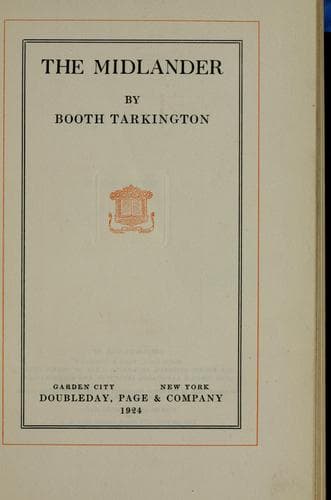
Middle West -- Fiction; Real estate developers -- Fiction; Suburbs -- Fiction
“What will people think of me,” she asked, “if you insist on going about
with two buttons off your vest, and looking as if you haven’t had
anything pressed since the flood? Whenever I do get one of your suits to
look respectable, you wear it out to the farm and forget to put your
overalls on, and then you climb trees, I suppose, or something else as
destructive; and after that you rush off downtown where everybody sees
you looking like the Old Scratch—that’s what your father said, and it
troubles him, too, dear. You were so particular all through college,
always just the very pink of fashion, and now, all of a sudden, you’ve
changed the way some young men do when they’ve married and get careworn
over having two or three babies at home. Won’t you try to reform, dear?”
He laughed and petted her, and went on as before, unreformed. Clerks,
glancing out of the great plate-glass windows of a trust company, would
giggle as they saw him hurrying by on his way from one office to
another, rehearsing to himself as he went and disfiguring his memorandum
book with hasty new mathematics. “There it goes again!” they would say,
perhaps. “Big Chief Ten-Years-From-Now, rushin’ the season in
year-before-last’s straw hat and a Seymour coat! Look at him talkin’ to
his old notebook, though! Guess that’s about all he’s got left he _can_
talk to without gettin’ laughed to death!”
Dan found one listener, however, who did not laugh, but listened to him
without interruption, until the oration was concluded, although it was
unduly protracted under the encouragement of such benevolent
circumstance. This was Mr. Joseph Kohn, the father of Dan’s former
partner in the ornamental bracket business. Kohn & Sons was an
establishment formerly mentioned by National Avenue as a “cheap Jew
dry-goods store”; and prosperous housewives usually laughed
apologetically about anything they happened to have bought there. But,
as the years went by, the façade of Kohn & Sons widened; small shops on
each side were annexed, and the “cheap dry-goods store” was spoken of as
a “cheap department store,” until in time it became customary to omit
the word “cheap.” Old Joe Kohn was one of the directors of the First
National Bank; he enjoyed the friendship of the president of that
institution, and was mentioned in a tone of respect by even the acrid
Shelby.
In the presence of this power in the land, then, Dan was profuse of his
utmost possible eloquence. Unchecked, he became even grandiose, while
the quiet figure at the desk smoked a cigar thoughtfully; and young Sam
Kohn, not yet admitted to partnership with his father and older brother,
but a floor-walker in the salesrooms below, sat with his elbows on his
knees and his chin on his fists, listening with admiration.
“My gracious, Dan,” he said, when the conclusion at last appeared to
have been reached;—“you are certainly a natural-born goods seller! I
wish we had you on the road for us.”
Public-domain text, read in full here on John Shaqi.
Reviews
Reviews
No reviews yet
Be the first to share your thoughts on this work.
Join the Discussion
Join the discussion
Sign in to leave a comment or review.
Sign InorCreate an account