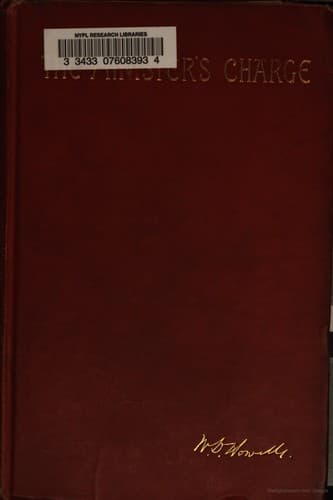
The Minister's Charge; Or, The Apprenticeship of Lemuel BarkerHowells, William Dean
General
The Minister's Charge; Or, The Apprenticeship of Lemuel Barker
Howells, William Dean
Boston (Mass.) -- Fiction; Clergy -- Fiction; Poets -- Fiction
The law-student, whose full name was Alonzo W. Berry, had one joking
manner for all manner of men and women, and Lemuel's suspicion could
not find any offensive distinction in it toward himself; but he disabled
Berry's own gentility for that reason, and easily learning much of the
law-student's wild past in the West from so eager an autobiographer, he
could not comfort himself with his friendship. While the student poured
out his autobiography without stint upon Lemuel, his shyness only
deepened upon the boy. There were things in his life for which he was in
equal fear of discovery: his arrest and trial in the police court,
his mother's queerness, and his servile condition at Miss Vane's. The
thought that Mr. Sewell knew about them all made him sometimes hate the
minister, till he reflected that he had evidently told no one of them.
But he was always trembling lest they should somehow become known at the
St. Albans; and when Berry was going on about himself, his exploits, his
escapes, his loves,--chiefly his loves,--Lemuel's soul was sealed within
him; a vision of his disgraces filled him with horror.
But in the delight of talking about himself, Berry was apparently
unaware that Lemuel had not reciprocated his confidences. He celebrated
his familiarity with Miss Swan and her friend, though no doubt he had
the greater share of the acquaintance,--that was apt to be the case with
him,--and from time to time he urged Lemuel to come up and call on them
with him.
“I guess they don't want _me_ to call,” said Lemuel with feeble
bitterness at last, one evening after an elaborate argument from Berry
to prove that Lemuel had the time, and that he just knew they would be
glad to see him.
“Why?” demanded Berry, and he tried to get Lemuel's reason; but when
Lemuel had stated that belief, he could not have given the reason for it
on his death-bed. Berry gave the conundrum up for the time, but he did
not give Lemuel up; he had an increasing need of him as he advanced in
a passion for Miss Swan, which, as he frankly prophesied, was bound to
bring him to the popping-point sooner or later; he debated with himself
in Lemuel's presence all the best form's of popping, and he said that it
was simply worth a ranch to be able to sing to him,
“She's a darling,
She's a daisy,
She's a dumpling,
She's a lamb,”
and to feel that he knew who _she_ was. He usually sang this refrain to
Lemuel when he came in late at night after a little supper with some of
the fellows that had left traces of its cheer on his bated breath.
Once he came downstairs alone in the elevator, in his shirt-sleeves and
stocking-feet, for the purpose of singing it after Lemuel had thought
him in bed.
Public-domain text, read in full here on John Shaqi.
Reviews
Reviews
No reviews yet
Be the first to share your thoughts on this work.
Elsewhere in the archive
Join the Discussion
Join the discussion
Sign in to leave a comment or review.
Sign InorCreate an account